
MODERN PHYSICS – 2018 – 2019
Recent Entrance Exams – Modern Physics – 2018/2019
01- (ABC Medical School – FMABC – SP – 019)

In 1990, Max Planck proposed that the radiation emitted by a source is not continuous, but rather composed of discontinuous portions.

In current language, we say that the radiation emitted by a source is composed of photons, whose energy is given by the relation Ef = hf, proposed by Planck, where Ef is the energy of each photon emitted, h is a constant with a value of 6.63.10−34 J . iff is the frequency of the radiation.
Assuming that a lamp emits radiation with a power of 8.0 W and a frequency of 6.0.1014 Hz, the number
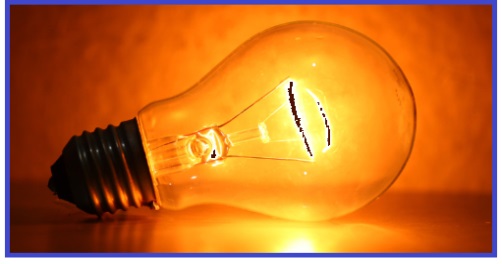
of photons that it emits every second is a value close to
a) 4.0.1019.
b) 8.0.1019.
c) 2.0.1014.
d) 4.0.1014.
e) 2.0.1019.
02- (UDESC-SC-019)
In 1900 Max Planck proposed the quantization of energy to explain blackbody radiation .

Planck’s postulate proposes that energy is given by E = nhf, where E is the energy, n is an integer, f is the frequency and h is a constant that later became known as Planck’s constant.
Select the alternative that corresponds to the unit of measurement in the international system of units .
A. ( ) Kg.m2/s B. ( ) Kg.m/s C. ( ) Kg.m2/s2 D. ( ) Kg.m/s E. ( ) Kg.m/s2
03- (State University of Central-West Paraná – UNICENTRO – 019)
The theory of special relativity, published in 1905 by the German Albert Einstein, impacted several areas of human knowledge and completely changed the way we observe and understand the universe around us.
It mainly dealt with the differences between physical phenomena observed from different reference frames.
The theory of special relativity was structured based on the following postulates:
I. The laws of physics are the same for observers in any inertial frame of reference. II. The laws of physics are the same for observers in any non-inertial frame of reference.
III. The speed of light in a vacuum has the same value regardless of the movement of the source or the observer’s reference system.
Regarding the postulates described above, identify which ones are correct.
a) Only postulate III is correct.
b) The correct postulates are I and III.
c) All postulates are correct.
d) The correct postulates are II and III.
e) The correct postulates are I and II.
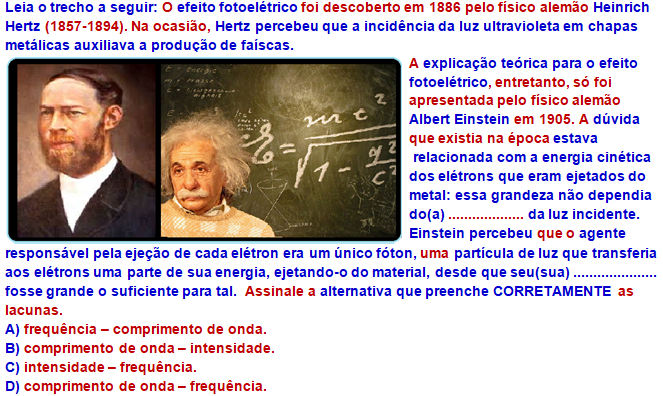
04-(UEMG-MG-019)
05- Federal University of Uberlândia – UFU – MG – mid-year – 2019/2020
There are processes that occur in the electronic structure of atoms in which an electron can gain or lose energy. In these processes , the electron passes from one energy level to another, and the energy difference between these two levels, in some of these processes, can be emitted as a photon of light.
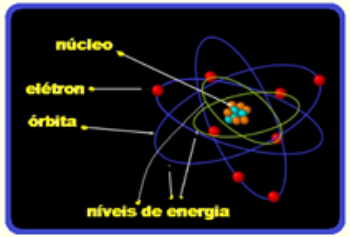
The photon has energy that can be determined by a direct relationship with the frequency of light through the equation E = h . f, where E is the energy of the photon, h is Planck’s constant (h = 6.6 x 10⁻³⁴ Js) and f is the frequency of the emitted light. In these situations, a widely used unit of energy is the electronvolt (eV), where 1 eV = 1.6 x 10⁻¹⁹ J.
Consider two electronic energy levels with values of E1 = -2.93 eV and E2 = -1.28 eV, and an electron that decays from level E2 to level E1, emitting a photon.
What is approximately the frequency of light associated with this photon?
A) 4.00 x 10¹⁴ Hz
B) 2.42 x 10¹⁵ Hz
C) 1.00 x 10¹⁵ Hz
D) 6.64 x 10¹³ Hz
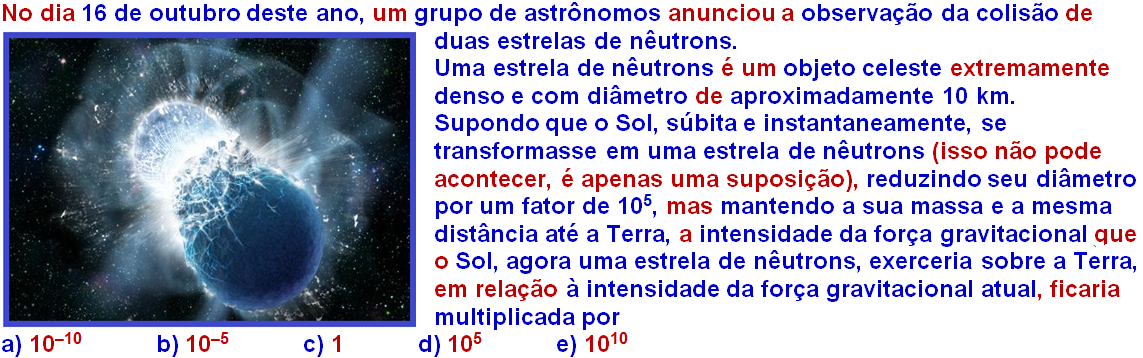
06- (FMABC-SP-018)
07- (UFJF-MG-018)
Joyce works with photoelectron spectroscopy, which is a material characterization technique that involves bombarding a material with X-rays of a certain energy and measuring the kinetic energy of the electrons torn from the surface of the material. This makes it possible to determine the chemical composition and the type of bond between the atoms of the sample being studied. Joyce wants to study a sheet of graphene, which is a material composed solely of carbon atoms. To do this, she uses two X-ray sources, A and B, which have frequencies of fA and fB, respectively, with fA > fB.
Three hypotheses are formulated regarding this experiment :
I – If we use source A, the electrons extracted from the graphene sheet reach the detector with a greater kinetic energy than that which would be measured if we used source B.
II – The electrons extracted from the S level, which is the innermost electronic level of the atoms, will reach the detector with greater energy than the electrons from the P layer, as they are more weakly bound to the nucleus, requiring less energy to pull them out.
III – The binding energy of electrons in carbon atoms is quantized.
Select the CORRECT statement regarding the hypotheses formulated:
Only I and II are correct.
- Only I and III are correct.
- Only I is correct.
- I, II and III are correct.
- Only II is correct.