
Hydrostatics – Density and Pressure – Resolution – EN
Diffraction and Dispersion of waves
Diffraction
Diffraction is the phenomenon that allows a wave to pass through gaps or go around obstacles,
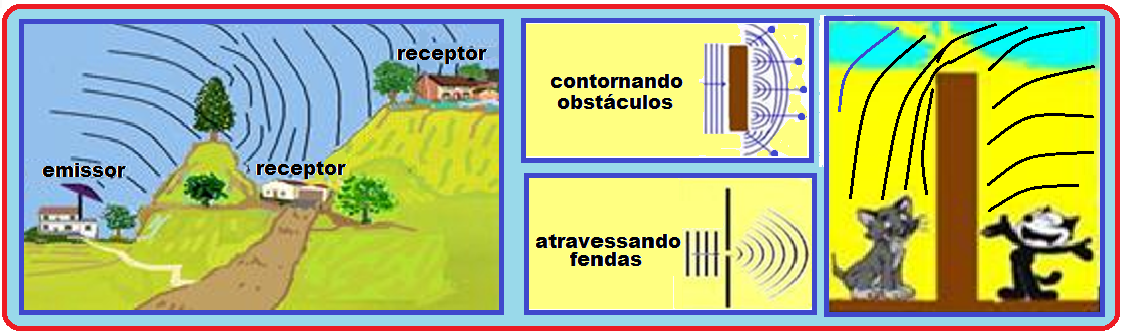
reaching regions where, according to the rectilinear propagation of light, it would not be able to reach.
Huygens’ Principle
Diffraction is explained by Huygens’ Principle which states that: “when the points of an opening or an obstacle are reached by the wave front they become sources of secondary waves that change the direction of propagation of the main wave , crossing the opening and going around the obstacle”.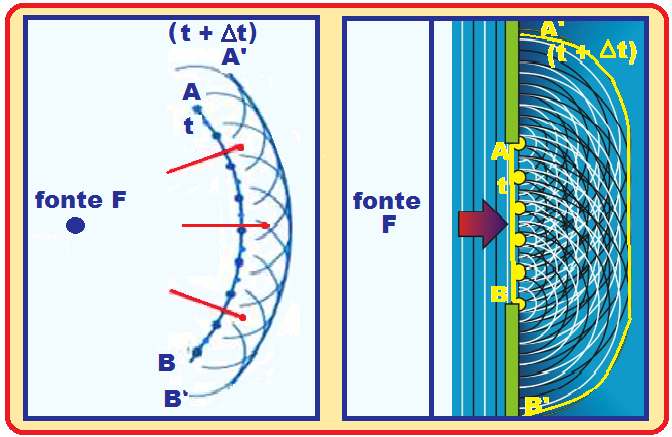
The sources F in the figure below are emitting periodic waves whose wavefront at time t is the surface AB.
On this wavefront AB we have infinite points that function as if they were secondary point sources that will form the new wavefront A’B’ in the following instants (t + Δt).
Waves are strongly diffracted when the wavelength λ is approximately the
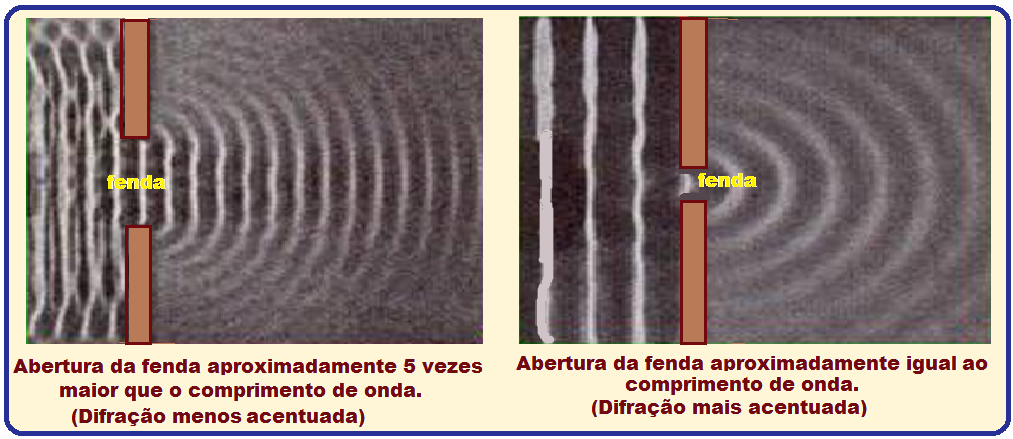
same size as the opening of the crack or the size of the obstacle.
For the reason above, diffraction occurs easily in sound waves , as they are waves with a long wavelength (ranging from 2cm to 20m).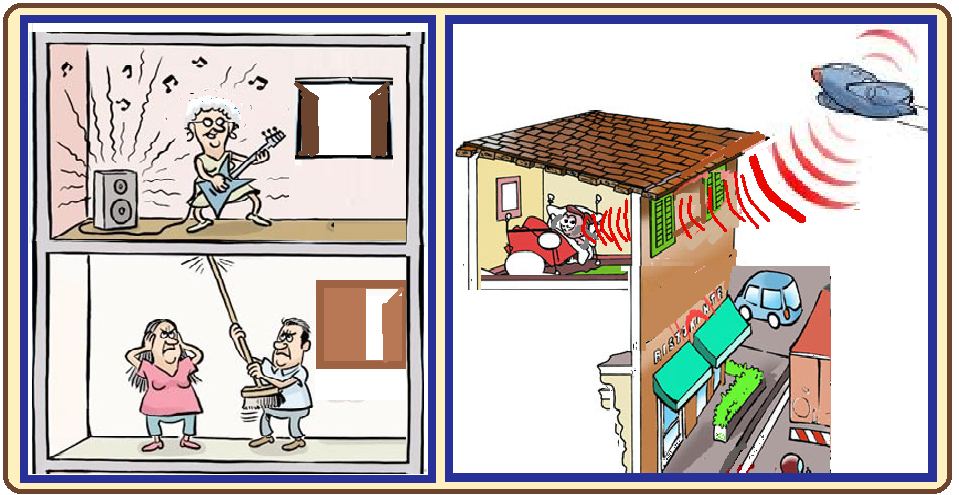
Thus, we can hear sounds even if we cannot see the source, as sound waves go around corners, walls, pass through doors, windows and any obstacles that are between 2cm and 20m in size.
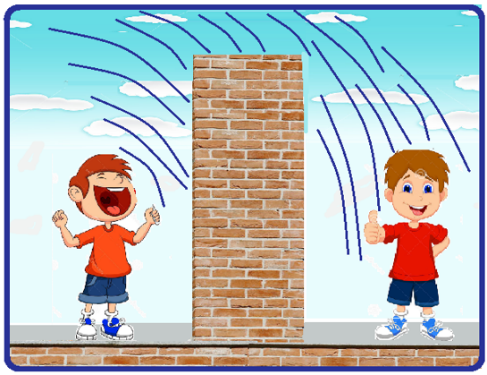
It is due to diffraction that the two boys in the figure to the side are communicating through the wall.
We must note that in the case of light waves, their wavelengths are very small (on the order of 10 -7 m) and for this reason the diffraction of light is not easily observed, since the openings and slits are much larger than the length of these waves.
In Figure 1, we have an incident wave whose wavelength (λ) is much smaller than the opening (d) and the wave passes through the slit. This is what happens when, for example, you make a hole the size of a heart and use a flashlight as a light source. The wavelength of the light is of the order of 10 -7 m; therefore, it is so small in relation to the space of the slit that diffraction does not occur.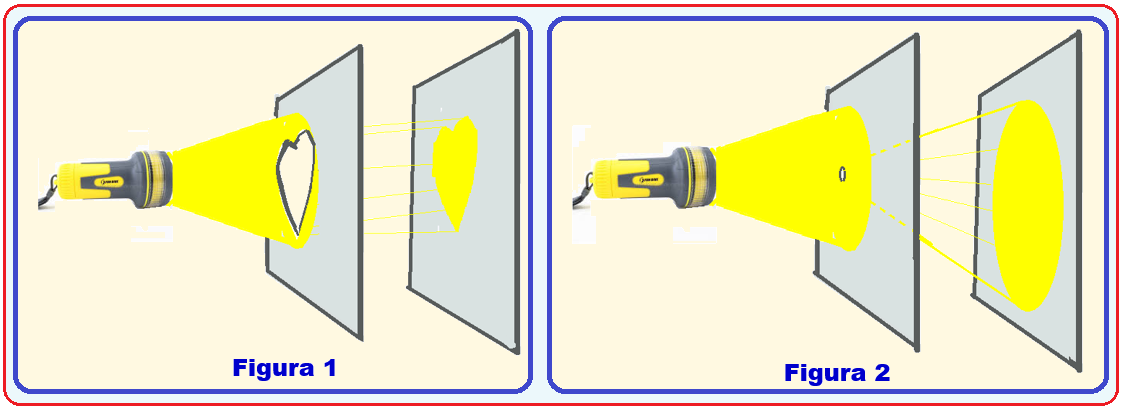
In figure 2, when a beam of parallel, monochromatic light rays hits the hole made by a needle in a card , they undergo diffraction and, after this, the light strip will widen instead of decreasing, as the diameter of the slit decreases so that the opening of the slit (d) and the wavelength (λ) are approximately the same size, or (d) is smaller than (λ).
Diffraction is only observed when the size of the hole is smaller or on the order of the wavelength of light.
Thus, the diffraction of light is only noticeable when it hits, for example, the thin end of a razor blade, the eye of a needle, etc.
Dispersal
Light dispersion is the phenomenon of separation of white polychromatic light into its component colors, which occurs when white light undergoes refraction, for example, in a glass prism (figures 1) or in water drops (figures 2).
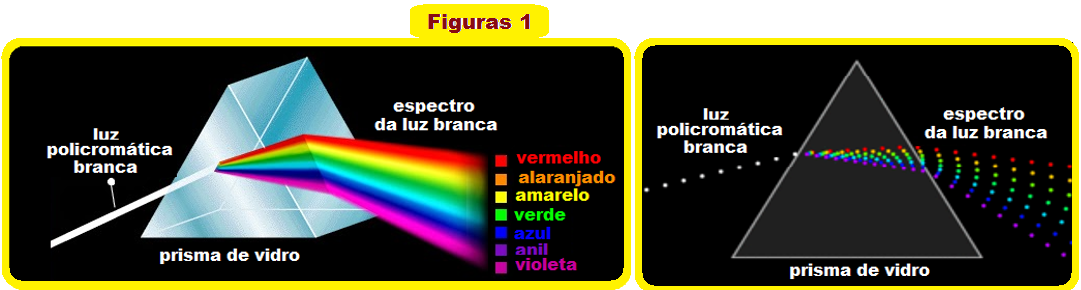
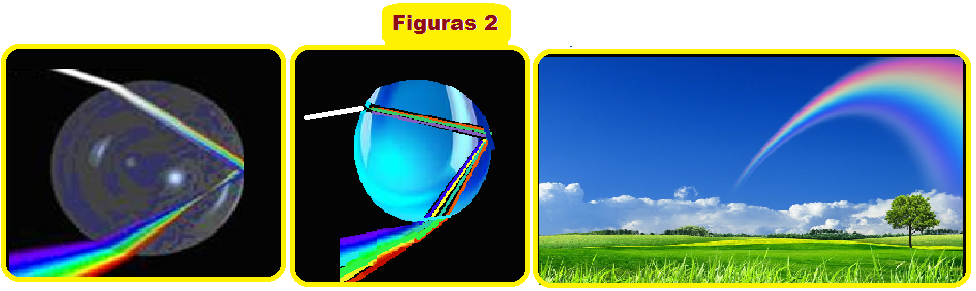
White polychromatic light is composed of infinite colors (frequencies), of which we highlight red, orange, yellow, green, blue, indigo and violet.
Important:
 In a vacuum and, approximately, in air, with an absolute refractive index of n = 1, all colors (frequencies) move at the same speed (3.0.10 8 m/s) and for this reason they are always together, forming white polychromatic light.
The absolute refractive index of a medium is a function of the frequency (color) of the light radiation that passes through it, its wavelength, and its propagation speed in that medium.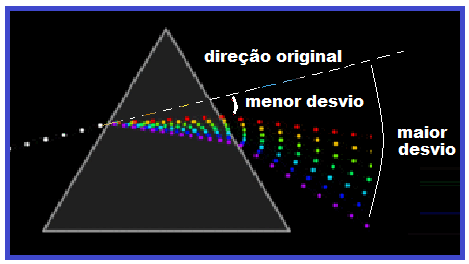
Thus, as white light is composed of infinite frequencies (colors), each of them, in a medium with a different refractive index than that of vacuum and air, moves at different speeds and undergoes different deviations.
The smallest deviation is red and the largest is violet.
What you should know, information and tips

Diffraction is the phenomenon that allows a wave to pass through gaps or go around obstacles,
reaching regions where, according to the rectilinear propagation of light, it would not be able to reach.
Diffraction is explained by Huygens’ Principle which states that: “when the points of an opening or an obstacle are reached by the wave front they become sources of secondary waves that change the direction of propagation of the main wave , crossing the opening and going around the obstacle”.
Waves , whether sound or light, will be strongly diffracted when the wavelength λ is approximately the same size as the object (obstacle or slit).
If the source is the same, the frequency of the wave is the same before and after diffraction.
If, after the barrier or the slit, the medium is the same, the wave propagation speed will also be the same.
Thus, the wavelength λ also remains the same, but the wave, after undergoing diffraction, reaches regions that would not be reached if only the rectilinear propagation of light were considered.

Light dispersion is the phenomenon of separation of white polychromatic light into its component colors, which occurs when white light undergoes refraction, for example, in a glass prism or in drops of water.
 In a vacuum and, approximately, in air, with an absolute refractive index of n = 1, all colors (frequencies) move at the same speed (3.0.10 8 m/s) and for this reason they are always together, forming white polychromatic light.
The absolute refractive index of a medium is a function of the frequency (color) of the light radiation that passes through it, its wavelength, and its propagation speed in that medium.
Thus, as white light is composed of infinite frequencies (colors), each of them, in a medium with a different refractive index than that of vacuum and air, moves at different speeds and undergoes different deviations.
The smallest deviation is red and the largest is violet.
White light is composed of infinite colors (frequencies) and there is no blue or red, but rather a certain range of frequencies in which each color predominates.
Light dispersion begins when light enters the prism and ends when light leaves it, that is, it occurs inside the prism.
Newton’s experiment on the dispersion of white polychromatic light
See how Isaac Newton described the proposed experiment that allowed him to rule out the influence of the prism glass as the cause of the dispersion of white light. 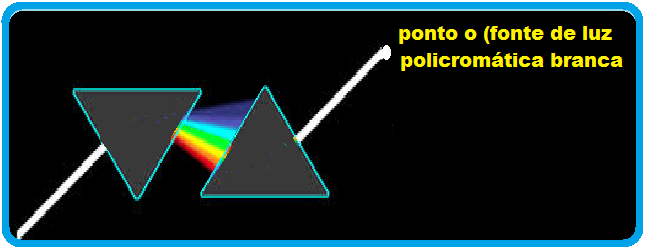
Considering that the light source was the hole O in the window of Newton’s room , see the description and drawing of the assembly carried out by his experiment:
“ I took another prism like the first and placed it so that the light would be refracted in opposite ways as it passed through both, and so in the end it would return to how it was before the first prism had dispersed it.”
The figure schematically represents the trajectory of a beam of white light passing through a drop of water . This is how a rainbow is created .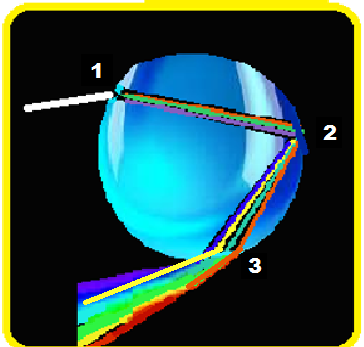
In 1 the optical phenomenon of refraction occurs, in 2 reflection and, in 3 again refraction.
The decomposition of white light (dispersion) occurs between 1 and 2 and between 2 and 3 and its cause is due to the fact that the absolute refractive index of the water in the drop is different for each frequency (color) of light, which causes different deviations in each one, separating them.
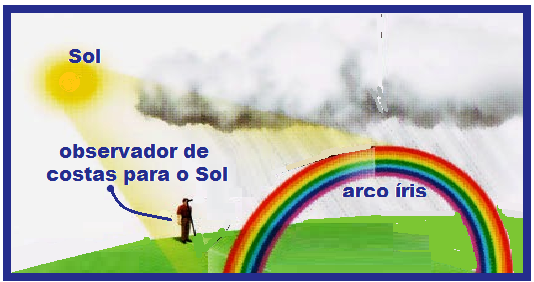
For the observer to see the rainbow, his position must be such that the Sun is behind him.

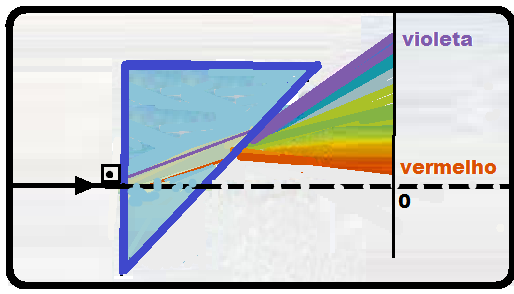
In the figure, with the white monochromatic light ray falling normally , it does not undergo deviation when entering the prism.
The deviation is upwards, since the incident ray and the refracted ray are always in quadrants opposite to those determined by the normal and red undergoes less deviation than violet.