
Sound Waves – Exercises – EN
Entrance exam exercises with commented solutions on
Sound Waves
01- (UNICAMP-SP) The shortest time interval between two sounds perceived by the human ear is 0.10s. Consider a person in front of a wall in a place where the speed of sound is 340m/s.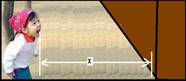
a) Determine the distance X at which the echo is heard 3.0 s after the voice is emitted.
b) Determine the shortest distance at which the person can distinguish your voice and the echo.
02-(PUC-RS) For the intelligible perception of two consecutive sounds, the time interval between them must be equal to or greater than 0.100s. Therefore, in a place where the speed of sound propagation in air is 350 m/s, for an echo to occur, the minimum distance between a person shouting their name in the direction of a high wall and said wall must be
a) 17.5m
b) 35.0m
c) 175m
d) 350m
e) 700m
03- (UFPEL) Recently, physicist Marcos Pontes became the first Brazilian astronaut to go beyond the Earth’s atmosphere.
There were daily contacts between Marcos and the base, and some of them were transmitted through the media.
Based on the text and your knowledge, it is correct to say that we were able to “hear” and “speak” with Marcos because, for this conversation, they were involved
a) only mechanical waves – transverse – since these propagate both in vacuum and in air.
b) only electromagnetic waves – longitudinal – since these propagate both in vacuum and in air.
c) electromagnetic waves – transverse – which have the same frequencies, speed and wavelength when passing from one medium to another.
d) mechanical waves – transverse – which have the same frequencies, speed and wavelength when passing from one medium to another.
e) both electromagnetic waves – transverse – that propagate in a vacuum, and mechanical waves – longitudinal – that require a material medium for their propagation.
04-(UFU-MG) Consider the graph below, which represents the quantity A as a function of time t (in
units of 10 -3 s).
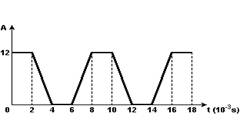
If quantity A represents the amplitude of a sound wave, determine its frequency.
05- (PUC-PR) One night, from the window of an apartment located on the 9th floor of a building, Mário observes a flash of lightning and after a few seconds he hears the noise of thunder corresponding to this discharge.
The most acceptable explanation for the fact is:
a) the emission of the sound signal takes longer than the emission of the light signal.
b) Mário’s sense of hearing is more precarious than his sense of sight.
c) the sound signal propagates in space at a slower speed than the light signal.
d) the sound signal, being a mechanical wave, is blocked by air molecules.
e) the path followed by the sound signal is longer than that of the light signal.
06-(UFMG-MG) When, in a flat region far from obstacles, the sound of an airplane flying is heard, it seems that this sound comes from a different direction than the one in which, at the same time, the airplane is seen.
Considering this situation, it is CORRECT to state that this occurs because
a) the speed of the plane is greater than the speed of sound in air.
b) the speed of the plane is less than the speed of sound in air.
c) the speed of sound is less than the speed of light in air.
d) sound is a longitudinal wave and light is a transverse wave.
07-(UFSCAR-SP) You already know that sound waves have a mechanical origin. Regarding these waves, it is correct to state that:
a) in air, all sound waves have the same wavelength.
b) the speed of the sound wave in air is close to the speed of light in that medium.
c) because they result from vibrations of the medium in the direction of their propagation, they are called transverse.
d) just like electromagnetic waves, sound waves propagate in a vacuum.
e) just like electromagnetic waves, sound waves also undergo diffraction.
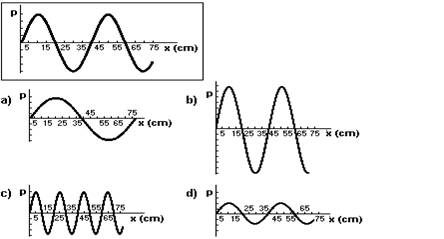
08- (UFMG-MG) When whistling, Rafael produces a sound wave of a certain frequency. This wave generates regions of high and low pressure along its direction of propagation.
The variation in pressure Dp as a function of position x, along this direction of propagation, at a certain instant, is represented in the following figure.
At another moment, Rafael whistles, producing a sound wave with a frequency twice as high as the previous one.
Based on this information, select the alternative whose graph best represents the graph of Dp as a function of x for this second sound wave.
09- (UERJ-RJ) Note in the figure below that the region of brain tissue to be investigated in the exam is limited by bones of the skull. The ultrasound emitter/receiver is supported on a point of the skull.
(Adapted from The Macmillan visual dictionary. New York: Macmillan Publishing Company, 1992.)
a) Assume that there is no lesion of any kind within the brain mass. Determine the time taken to record the echo from point A in the figure.
b) Now suppose there is a lesion. Knowing that the time taken to record the echo was 0.5 x 10 -4 s, calculate the distance from the lesioned point to point A.
Given: speed of ultrasound in the brain = 1540 m/s
10- (UERJ-RJ) A bell emits sound with a frequency of 1 kHz. The wavelength of this sound wave is, in centimeters, equal to: V sound in air = 340 m/s

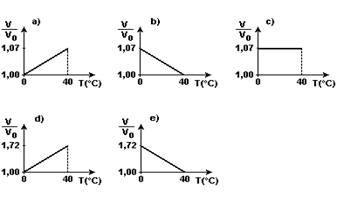
11- (UFRS-RS) At a temperature of 0 °C, the speed (V o ) of sound propagation in dry air is 330 m/s. It is known that the speed (V) of sound propagation in air depends on the temperature and that it undergoes an average linear increase of 0.59 m/s for each increase of 1 °C.
Select the graph that best represents the variation of the V/V³ quotient as a function of temperature.
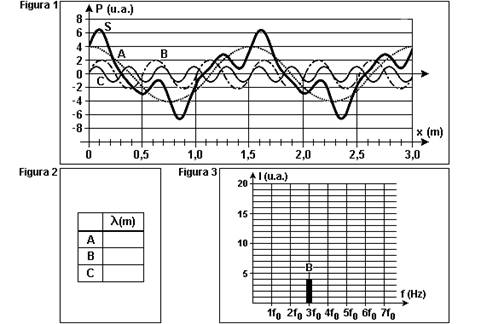
12- (FUVEST-SP) The sound produced by a certain musical instrument, far from the source, can be represented by a complex wave S, described as a superposition of sinusoidal pressure waves, as shown in figure 1. It represents the variation of pressure P as a function of position, at a certain instant, with the three components of S identified by A, B and C.
a) Determine the wavelengths, in meters, of each of the components A, B and C, filling in the table in figure 2.
b) Determine the wavelength l o , in meters, of the S wave.
c) Represent, in the graph, as shown in figure 3, the intensities of components A and C.
In this same graph, the intensity of component B is already represented, in arbitrary units.
NOTE AND ADOPT:
ua = arbitrary unit
Speed of sound ¸ 340 m/s
The intensity I of a sinusoidal wave is proportional to the square of the amplitude of its pressure wave.
The frequency f o corresponds to the component that has the lowest frequency.
13-(UNESP-SP) A submarine is equipped with a device called sonar, which emits acoustic waves of frequency 4.00.10 4 Hz. The speed of the waves emitted in air and water are, respectively, 3.70.10 2 m.s -1 and 1.40.10 3 m.s -1 .
This submarine, when resting on the surface, emits a signal in a vertical direction through the ocean and the echo is received after 0.80s. The question is:
a) How deep is the ocean at this location?
b) What is the ratio of the wavelength of sound in air to that in water?
14-(UNESP-SP) In recent decades, cinema has produced countless science fiction films with scenes of space wars, such as Star Wars.


With the exception of 2001: A Space Odyssey, these scenes feature explosions with impressive bangs, as well as spectacular lighting effects, all in interplanetary space.
a) Comparing Star Wars, which features sound effects and explosions, with 2001: A Space Odyssey, which does not, which one is in accordance with the laws of physics? Justify.
b) What about the light effects that everyone presents? Justify.
.
15-(ITA-SP) A gong is struck every 0.5 s using an electromechanical process. A person standing very close to the gong sees and hears the strikes simultaneously. Moving away a little from the gong, the person starts to hear the sound a little after it is struck; however, when the person is 172 m away from the gong, the sound and image once again become simultaneous. Determine the speed of sound under the conditions of the experiment.
16-(UERJ-RJ) A geotechnician on board a small vessel is at a certain distance from a vertical wall that has a submerged part. Using a sonar that works both in water and at sea, he observes that, when the device is submerged, the time interval between the emission of the signal and the reception of the echo is 0.731s, and that, when the device is submerged, the time interval between emission and reception decreases to 0.170s.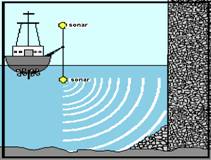
Calculate:
a) the ratio V water /V air between the speed of sound in water and the speed of sound in air.
b) the ratio l water / l air between the wavelength of sound in water and the wavelength of sound in air.
17- (FUVEST-SP) The sound of a whistle is analyzed using a meter that, on its screen, displays the pattern shown in the figure below.
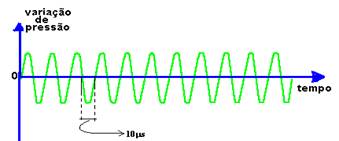
The graph represents the variation in pressure that the sound wave exerts on the meter, as a function of time, in ms
(1ms=10 -6 s).
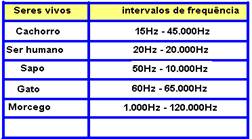
Analyzing the table of audible frequency ranges, by different living beings, it is concluded that this whistle can only be heard by: (speed of sound in air = 340 m/s)
a) humans and dogs
b) humans and frogs
c) frogs, cats and bats
d) cats and bats
e) bats
18-(FUVEST-SP) There is a sound source at vertex A of an equilateral and horizontal triangular track, 340m on each side. The source emits a signal that, after being reflected successively at B and C, returns to point A. At the same time that the source is activated, a runner leaves point X, located between C and A, towards A, at a constant speed of 10m/s.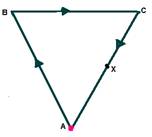
If the runner and the reflected signal reach A at the same time, the distance AX is: (V sound = 340 m/s)
a) 10m
b) 20m
c) 30m
d) 340m
e) 1,020m
19- (Furg-RS) Sonar is a device capable of emitting sound waves into the water and capturing their echoes (reflected waves), thus allowing the location of objects underwater. Knowing that a submarine’s sonar receives the waves reflected by the hull of a ship 6 seconds after they are emitted and that the speed of sound propagation in seawater is 1,520 m/s, determine the distance between the submarine and the ship.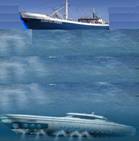
The speeds of the submarine and the ship are negligible compared to the speed of sound.
20-(UNESP-SP) The wave-like nature of sound can be used to eliminate, in whole or in part, unwanted noise. To do this, microphones capture the noise from the environment and send it to a computer, programmed to analyze it and emit a wave-like signal that cancels out the original unwanted noise. The wave-like phenomenon on which this new technology is based is:
a) interference
b) diffraction
c) polarization
d) reflection
e) refraction
21-(MACKENZIE-SP) A blacksmith strikes an iron blade with a sledgehammer at a uniform pace every 0.9s.
An observer, far from this blacksmith, sees, through binoculars, the hammer hitting the iron and hears the sound of the blows simultaneously.
The speed of sound, under local conditions, is 330 m/s. The shortest distance between the blacksmith and the observer is:
a) 140m
b) 224m
c) 297m
d) 375m
e) 596m
22- (FUVEST-SP) A speaker emits a sound whose frequency F, expressed in Hz, varies according to
of time t in the form F(t) = 1,000 + 200t. At a given moment, the speaker is emitting a sound with a frequency F 1 = 1,080Hz. At that same moment, a person P, standing at a distance D = 34m from the speaker, is hearing a sound with a frequency F 2 , approximately equal to: (speed of sound in air = 340m/s)
a) 1,020Hz
b) 1,040Hz
c) 1,060Hz
d) 1,080Hz
e) 1,100Hz
23- (PUC-MG) A hammer is struck at the end of a rail. At the other end, there is a person who hears two sounds separated by a time interval of 0.18s. The first of the sounds propagates through the rail at a speed of 3400 m/s, and the second through the air, at a speed of 340 m/s. The length of the rail in meters will be:
a) 340m
b) 68m
c) 168m
d) 170m
24-(ENEM-MEC)

Electromagnetic waves, such as visible light and radio waves, travel in straight lines in a homogeneous medium. Therefore, radio waves emitted in the coastal region of Brazil would not reach the Amazon region of Brazil because of the curvature of the Earth. However, we know that it is possible to transmit radio waves between these locations due to the ionosphere. With the help of the ionosphere, the transmission of plane waves between the coast of Brazil and the Amazon region is possible through the
a) reflection.
b) refraction.
c) diffraction.
d) polarization.
e) interference.
25-(PUC-SP)

Patrícia hears the echo of her direct voice, reflected by a large flat mirror, at the exact time it takes to blink an eye, after the emission. Adopting the speed of sound in air as 340 m/s and the average time of a blink equal to 0.4 s, we can state that the distance d between the girl and the mirror is
a) 68 m
b) 136 m
c) 850 m
d) 1,700 m
e) 8,160 m
26-(UEPG-PR)

Regarding wave phenomena, indicate what is correct.
01) When passing from one medium to another, a wave’s frequency changes.
02) When a wave is reflected by a barrier, the angle of incidence is equal to the angle of reflection.
04) In a transverse wave, the points in the medium in which it propagates vibrate perpendicularly to the direction of its propagation.
08) The propagation speed of a wave depends on the medium in which it propagates.
27- (UEPB-PB)

SONAR (sound navigation and ranging) is a device that, installed on ships and submarines, allows measuring ocean depths and detecting the presence of obstacles. It was originally developed for military purposes during the Second World War (1939-1945) to allow the location of submarines and other enemy vessels. Its principle is quite simple, and is illustrated in the figure below.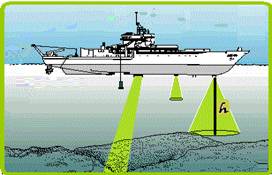
Initially a sound impulse is emitted by a device installed on the ship. Its dominant frequency is
typically 10 kHz to 40 kHz. The sound signal propagates in the water in all directions until it encounters an obstacle. The sound signal is then reflected (echo) directing some of the energy back to the ship where it is detected by a hydrophone. (Adapted from JUNIOR, FR The Fundamentals of Physics. 8th ed. vol. 2. São Paulo: Moderna, 2003. p. 417)
Regarding the subject discussed in the text, analyze the following problem situation:
A submarine is equipped with a device called sonar, which emits sound waves of frequency 4.0.10 4 Hz. The speed of propagation of sound in water is 1.60.10 3 m/s. This submarine, when at rest on the surface, emits a signal in a vertical direction through the ocean and the echo is received after 0.80 s. The depth of the ocean at this location and the wavelength of the sound in the water, in meters, are, respectively:
a) 640 and 4.10 -2
b) 620 and 4.10 -2
c) 630 and 4.5.10 -2
d) 610 and 3.5.10 -2
e) 600 and 3.10 -2
28-(UNEMAT-MT)

In the past, during a storm, people used to say that lightning had struck far away if the corresponding thunder was heard much later; or that it had struck nearby if the opposite happened.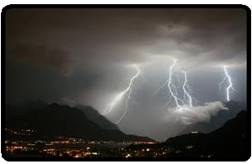
From a Physics point of view, this statement is based on the fact that, in air, the speed of sound:
a. vary as a function of the speed of light.
b. be much larger than that of light.
c. be the same as that of light.
d. vary with the inverse square of the distance.
and be much smaller than that of light.
29-(UNIOESTE-PR)

In a final exam in experimental physics, a student was asked to express the speed of sound propagation (v) in air from the local atmospheric pressure (P) and the air density (ρ). He remembered only that
the expression sought was independent of dimensionless constants and, therefore, after carrying out the dimensional analysis of the problem, he correctly concluded that
A. v = (P/ρ) 2 .
B. v = (ρ/P) 2 .
C. v = (P/ ρ ) 1/2 .
D. v = ( ρ /P) 1/2 .
E. v = (P. ρ ) 1/2 .