
Sound Waves – EN
Sound Waves
Acoustics
Acoustics  Part of physics that studies sound and its various manifestations. More specifically,

Physical acoustics studies the material part of the sound phenomenon, while psychoacoustics deals with the perception of the sound phenomenon by the senses.
Wave physics is the part of physics that studies phenomena that present themselves in the form of waves and, as sound is the result of the perception of disturbances in the molecules of a medium in a certain space of time, these disturbances , in turn, present themselves in the form of waves as they propagate through the medium, and are called sound waves.
Sound waves
The pressure waves that characterize sound, called sound waves, are mechanical waves ( they require a material medium to propagate) and longitudinal waves ( the direction of vibration coincides with the direction of propagation).
They do not propagate in a vacuum (there is no material medium for their propagation).
They are produced by any vibratory movement and expand in space (three dimensions) by
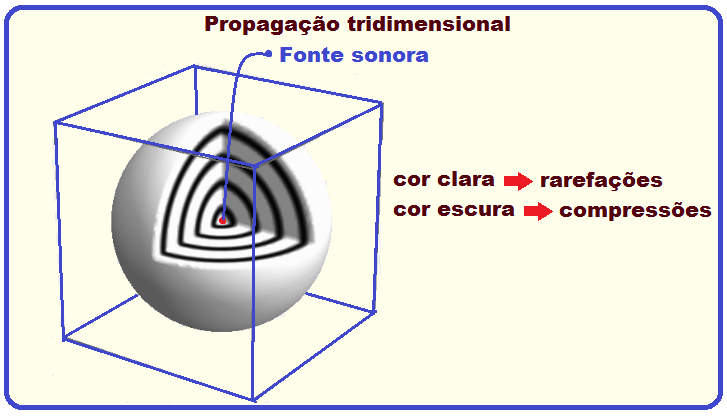
through compressions and rarefactions, until they reach our ears, where the eardrums, for
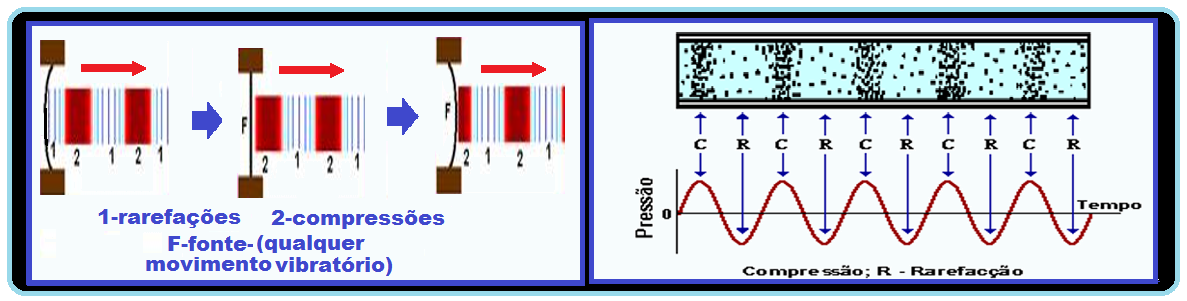
resonance, are induced to vibrate at the same frequency as the source and cause us the physiological sensation of sound.
The average range of audible frequencies for a normal human ear ranges from 20Hz to 20,000Hz.
Waves with frequencies lower than 20Hz are infrasound and higher than 20,000Hz are ultrasound.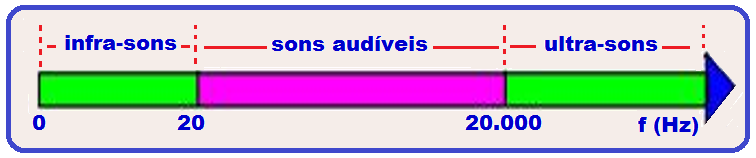
Infrasonic and ultrasonic waves are not audible to the human ear, but there are animals ( moles and elephants, for example) that can capture infrasounds, being able to hear the waves from earthquakes (a few Hz).
Ultrasounds can be heard by certain animals such as bats (up to 160,000 Hz) , dogs and

cat (up to 40,000 Hz) and also used in medicine (echocardiography, obstetric ultrasound, etc.).
Speed of sound
Most sounds reach the ear transmitted through air (transmission medium), which, the denser it is, the better the transmitter, as the molecules are closer together, transmitting energy better from one to the other.
For this reason, the speed of sound in solids is greater than in liquids, which in turn is greater than in gases. 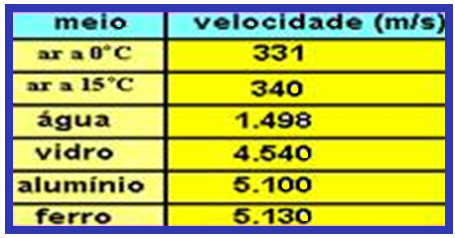
The speed of sound propagation in a given medium depends on the temperature at which that medium is found.
Thus, there is an increase in the speed of sound propagation in a given medium when its temperature increases ( greater agitation of the particles).
This occurs in the temperature range close to room temperature.
See in the table that, for example, the speed of sound in air at 0 ° C (331 m/s) is lower than that in air at 15 ° C (340 m/s).
Comparison between the speed of sound and the speed of light

Fundamental wave equation for a sound wave

Due to its longitudinal nature , sound cannot be polarized, but as with any sound wave, other phenomena can occur , such as diffraction, reflection, refraction, interference and the Doppler effect.
Sound reflection
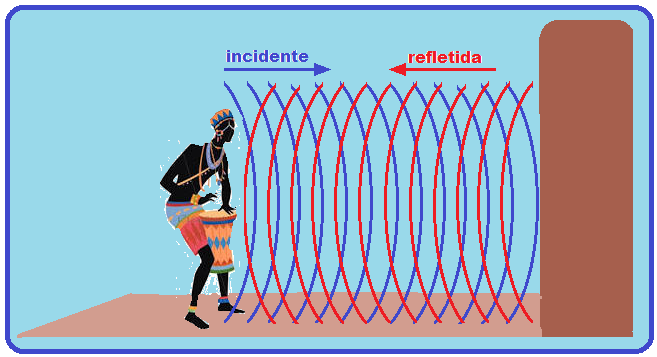
Sound reflection is a phenomenon that occurs when sound that was propagating in a medium,
hits a reflective surface and returns to the source medium.
This phenomenon gives rise to echo and reverberation.
Echo
Echo is a phenomenon in which we can clearly hear a sound reflected by reflective obstacles, one or more times in succession .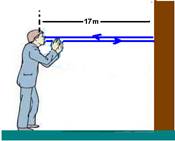
Our ear can only distinguish two successive sounds in a time interval equal to or greater than 0.10 seconds.
Since the speed of sound in air is 340 m/s, we have that V = ΔS/Δt 340=ΔS/0.1 ΔS=34m (round trip).
Thus, a person can hear the echo of their own voice if they are at least 17m away from the reflective obstacle.
Reverberation
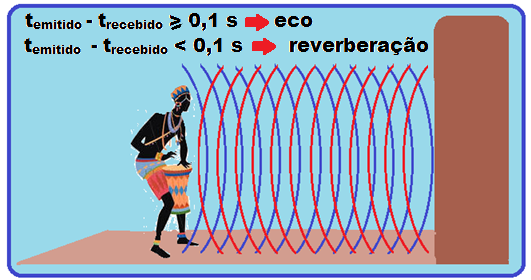
Reverberation occurs when direct and reflected sound overlap and arrive at the ear together ,
which occurs when the reflecting surface is less than 17m from the emitting source.
Sounds decrease or increase in intensity and become indistinct, as many reflections reach the listener and he or she cannot distinguish one from the other.
Sonar
Sonar is a device that emits ultrasounds, which reach objects, are reflected and capture the echoes, allowing them to be located by measuring the time between the emission and reception of the sound, knowing the speed of propagation of sound in water. 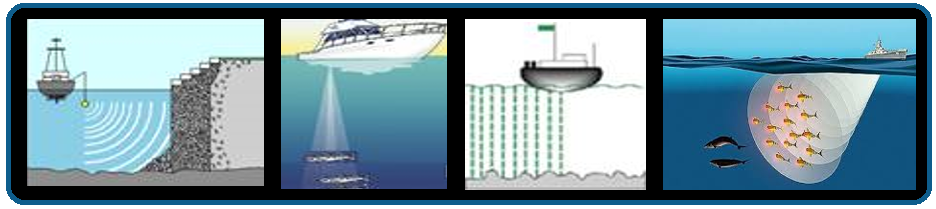
Widely used in navigation guidance, providing the profile of the seabed and locating schools of fish.
To obtain images of the external and internal parts of any object (ships, submarines, etc.) immersed in the seabed, sound must be used through the ultrasound sent by the sonar. The sound can pass through the surface of the sediments, penetrating them, and be able to
define the geometry of the internal layers through the echoes, which arrive at different times at the receiver on the surface, thus obtaining a 3D figure of the sunken element.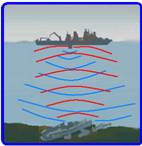
Light is not convenient, since it is attenuated (reflected or absorbed) in the first initial layers of sediments, not being able to penetrate them, and only the superficial shapes of the sediments would be visualized.
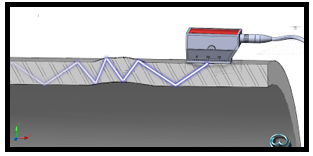
The same happens when you want to study the internal parts of metals (material structure).
Radar
Radar works like sonar, but instead of ultrasonic waves, it emits

electromagnetic waves that are reflected by distant objects, thus allowing their location.
Ultrasound or ultrasound
Ultrasound or ultrasound is a diagnostic method that allows , through echo , to see the movements produced by the
various organs within the body.
When the ultrasound is placed, through the transducer, on the patient’s skin, the sounds it emits are reflected in the internal organs or structures and return as echoes, which are sounds that the transducer electronically modifies and transforms into images.
What you should know, information and tips
 Understand the above information about echo, reverberation, sonar, radar and ultrasound.
Sound waves  are mechanical waves (they require a material medium to propagate) that are longitudinal (the direction of vibration coincides with the direction of propagation).
They do not propagate in a vacuum
The average range of audible frequencies for a normal human ear ranges from 20Hz to 20,000Hz.
Waves with frequencies lower than 20Hz are infrasound and higher than 20,000Hz are ultrasound.
Infrasonic and ultrasonic waves are not audible to the human ear, but there are animals ( moles and elephants, for example) that can capture infrasounds, being able to hear the waves from earthquakes (a few Hz).
Ultrasounds can be heard by certain animals such as bats (up to 160,000 Hz) , dogs and
cat (up to 40,000 Hz) and also used in medicine (echocardiography, obstetric ultrasound, etc.).
 Comparison between the speed of sound and the speed of light
Fundamental wave equation for a sound wave
Frequency is a characteristic of the wave. If the source is the same, the frequency of the wave is the same as the source, regardless of the medium in which it is propagating.
Echo phenomenon in which we can clearly hear a sound reflected by reflective obstacles, one or more times in succession.
Our ear can only distinguish two successive sounds in a time interval equal to or greater than 0.10 seconds. Thus, a person can hear the echo of their own voice if they are at least 17 m away from the reflecting obstacle.
Some interesting exercises so you can observe and understand the resolution:
01- (UNESP-SP) In recent decades, cinema has produced countless science fiction films with scenes of space wars, such as Star Wars.

With the exception of 2001: A Space Odyssey, these scenes feature explosions with impressive bangs, as well as spectacular lighting effects, all in interplanetary space.
a) Comparing Star Wars, which features sound effects and explosions, with 2001: A Space Odyssey , which does not, which one is in accordance with the laws of physics? Justify.
b) What about the light effects that everyone presents? Justify.
Resolution:
a) 2001: A Space Odyssey is in accordance with the laws of physics, as sound does not propagate in the vacuum of interplanetary space.
b) Both are correct, as light propagates in a vacuum.
02 – (ITA-SP) A gong is struck every 0.5 seconds using an electromechanical process . A person standing very close to the gong sees and hears the strikes simultaneously. If they move a little away from the gong, they start to hear the sound a little after it strikes; however, when the person is 172m away from the gong, the sound and image become simultaneous again.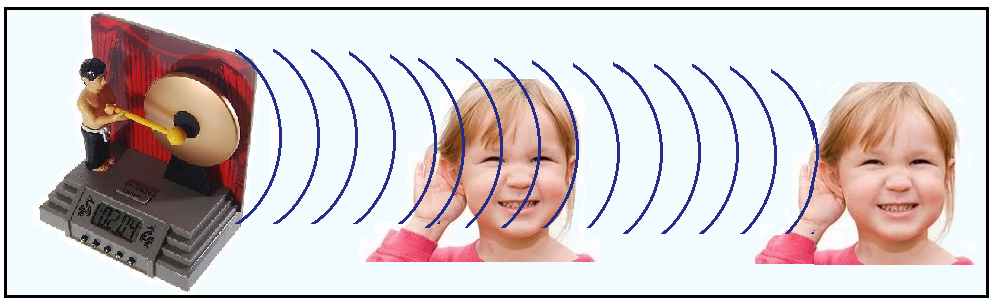
Determine the speed of sound under the conditions of the experiment.
Resolution:
When, again, sound and image are simultaneous, the person will be hearing the sound of the previous blow, which will be traveling the distance of 172 m in 0.5 s.
V = ΔS/Δt V=172/0.5 V = 344 m/s.
03- (MACKENZIE-SP) A blacksmith strikes an iron blade with a sledgehammer , at a uniform pace, every 0.9 s.
An observer, far from this blacksmith, sees, through binoculars, the hammer hitting the iron and hears the sound of the blows simultaneously.
The speed of sound , under local conditions, is 330 m/s. Calculate the shortest distance between the blacksmith and the observer.
Resolution:
The sound reaches the observer with a delay and the sound and image will be simultaneous when the delay is a multiple of the period of the hammer blows, that is, every 0.9s, 1.8s, 2.7s, etc.
In this case, the shortest distance occurs with a delay of Δt = 0.9 s.
V = ΔS/Δt 330 = ΔS/0.9 ΔS = 297 m.
04- (FUVEST-SP) A speaker emits a sound whose frequency F , expressed in Hz , varies as a function of time t in the form F(t) = 1,000 + 200t.
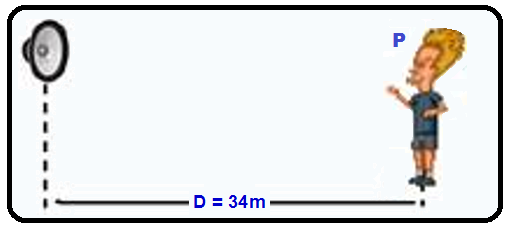
At a given moment, the speaker is emitting a sound with a frequency F 1 = 1,080 Hz.
At the same instant, a person P, standing at a distance D = 34 m from the speaker , is hearing a sound with a frequency F 2 , approximately equal to how many Hz? (speed of sound in air = 340 m/s)
Resolution:
Calculation of the instant at which the speaker is emitting sound with frequency F 1 = 1,080 Hz
F(t) = 1000 + 200t 1080 = 1000 + 200t t 1 = 0.4 s.
Calculation of the time interval that any sound with V = 340 m/s emitted by the source takes to reach person P who is D = 34 m from the source V = ΔS/Δt 340 = 34/Δt Δt = 0.1s.
Thus, the sound that is being heard by the person at instant t 1 = 0.4s was emitted by the source at instant t o = t 1 – ∆t = 0.4s – 0.1s = 0.3s .
The frequency of this sound is given by f = 1000 + 200 . 0.3 F = 1000 + 200. 0.3 F 2 = 1,060 Hz.