
VECTORS – VECTOR KINEMATICS
Vectors – Vector Kinematics
Exercises with ENEM characteristics
01-(FUVEST-SP)

A traveler left Araripe, in Ceará, and initially traveled 1,000 km south, then 1,000 km
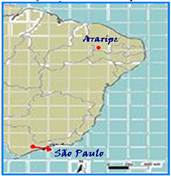
to the west and, finally, another 750 km to the south. Based on this route and the map above, it can be said that, during his journey, the traveler passed through the states of Ceará,
a) Rio Grande do Norte, Bahia, Minas Gerais, Goiás and Rio de Janeiro, having visited the ecosystems of Caatinga, Atlantic Forest and Pantanal. He ended his trip about 250 km from the city of São Paulo.
b) Rio Grande do Norte, Bahia, Minas Gerais, Goiás and Rio de Janeiro, having visited the ecosystems of Caatinga, Atlantic Forest and Cerrado. He ended his trip approximately 750 km from the city of São Paulo.
c) Pernambuco, Bahia, Minas Gerais, Goiás and São Paulo, having visited the ecosystems of Caatinga, Atlantic Forest and Pantanal. He ended his trip approximately 250 km from the city of São Paulo.
d) Pernambuco, Bahia, Minas Gerais, Goiás and São Paulo, having visited the ecosystems of Caatinga, Atlantic Forest and Cerrado. He ended his trip approximately 750 km from the city of São Paulo.
e) Pernambuco, Bahia, Minas Gerais, Goiás and São Paulo, having visited the ecosystems of Caatinga, Atlantic Forest and Cerrado. He ended his trip approximately 250 km from the city of São Paulo.
02-(UnB-DF)

Consider a clock with a circular dial with a radius of 10 cm and whose minute hand has a length equal to the radius of the dial.

dial. Consider this pointer as a vector with origin at the center of the clock and variable direction.
The module of the sum of the three vectors determined by the position of this hand when the clock marks exactly 12 hours, 12 hours and 20 minutes and, finally, 12 hours and 40 minutes is, in cm, equal to:
a) 30.
b) 10(10 + √3).
c) 20.
d) zero.
e) 10
03-(UFC-CE)

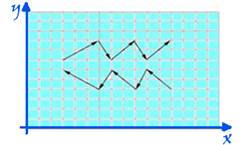
In the following figure, where the grid forms squares with side L=0.50cm, ten vectors are drawn, contained in the xy plane. The module of the sum of all these vectors is, in centimeters:

04-(UFPB-PB)

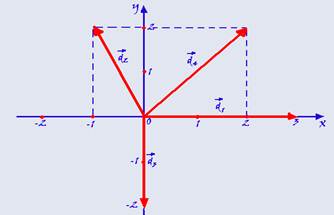
A billiard ball undergoes four successive displacements represented by the vectors  shown in the diagram
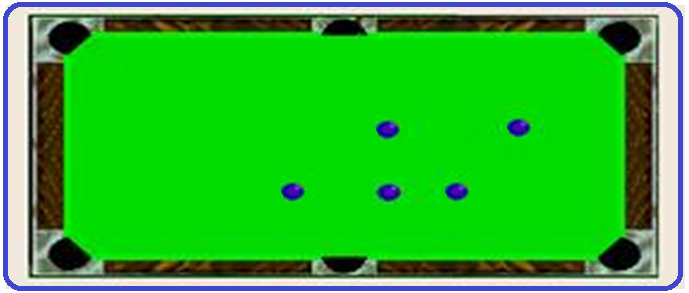
below

05-(UFMG-MG)

A boy floats on a buoy that is moving along the current of a river. Another buoy, floating in the same river at a distance from the boy, is also moving downstream. The positions of the two buoys and the direction of the current are indicated in the figure.
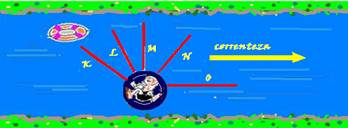
Consider that the speed of the current is the same at all points of the river. In this case, to reach the second buoy, the boy must swim in the direction indicated by the line:

06-(UFRN-RN)

Consider a large ship, such as an ocean liner, moving in a straight line and at constant speed (cruising speed).
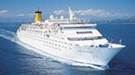
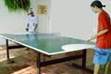
Inside, there is an air-conditioned games room with a ping-pong table oriented parallel to the length of the ship. Two young men decide to play ping-pong, but they disagree about who should face or back to the direction the ship is moving. According to one of them, this choice would influence the outcome of the game, since the movement of the ship would affect the relative movement of the ping-pong ball.
In this context, according to the Laws of Physics, it can be stated that
a) the discussion is not relevant, since, in this case, the ship behaves as a non-inertial reference frame, not affecting the movement of the ball.
b) the discussion is pertinent, since, in this case, the ship behaves as a non-inertial reference frame, not affecting the movement of the ball.
c) the discussion is pertinent, since, in this case, the ship behaves as an inertial reference, affecting the movement of the ball.
d) the discussion is not relevant, since, in this case, the ship behaves as an inertial reference frame, not affecting the movement of the ball.
07-(UFAL-AL)

From inside a car in uniform rectilinear motion, on a horizontal road, a student looks out the side window and observes the rain falling, making an angle (θ) with the vertical direction, with senθ = 0.8 and cos θ = 0.6.
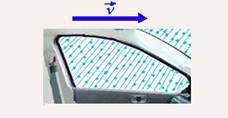
For a person standing on the road, rain falls vertically, with a constant speed of module v. If the car’s speedometer reads 80.0 km/h, it can be concluded that the value of v is equal to:
a) 48.0 km/h
b) 60.0 km/h
c) 64.0 km/h
d) 80.0 km/h
e) 106.7 km/h
08-(UFMS-MS)

Consider a river without curves and with a calm flow without turbulence, with a constant width equal to L. Consider the flow represented by velocity vectors parallel to the banks and which increase uniformly with the distance from the bank, reaching the maximum value v max in the middle of the river.
From then on, the flow velocity decreases uniformly, reaching zero at the edges. This happens because the flow friction is more intense near the edges.
A fisherman, in an attempt to cross this river, starts from the lower bank at point O with a boat directed perpendicular to the banks and with a constant speed in relation to the water, and equal to u. The dotted lines, in the figures, represent possible trajectories described by the boat when crossing the river leaving from point O and arriving at point P on the upper bank. Based on the concepts of kinematics, indicate the CORRECT alternative.
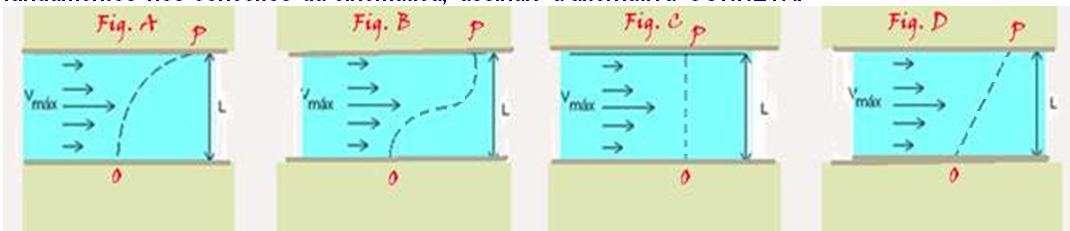
a) Figure A correctly represents the trajectory of the boat; and the time t to cross the river is equal to t = L/(v max +u).
b) Figure B correctly represents the trajectory of the boat; and the time t to cross the river is equal to t = L/u.
c) Figure C correctly represents the trajectory of the boat; and the time t to cross the river is equal to t = L/u.
d) Figure B correctly represents the boat’s trajectory; and the time t to cross the river is equal to t = L/(u+v max ).
e) Figure D correctly represents the trajectory of the boat; and the time t to cross the river is equal to t = L/u.
09-(MACKENZIE-SP) A passenger on a train, which is moving to the right in a uniform rectilinear motion, observes the rain through the window. There is no wind and the raindrops have already reached their limit speed. The appearance of the rain observed by the passenger is:
