
Geometric Optics – Lenses – Geometric Construction of Images – EN
Commented Resolution
Geometric Optics
Lenses – Geometric Construction of Images
01- R- C — read information below:
 Lens – A device made of homogeneous, transparent material in which one surface is flat and the other spherical, or both surfaces are spherical.
They will be called thin lenses when their thickness is negligible in relation to their radius of curvature, which is the radius of the circle(s) that generated them.
They are:
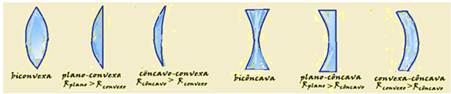
As we normally have glass lenses immersed in air, so in this case, thin edged lenses are converging lenses and thick edged lenses are diverging lenses.
02- R- B — see all cases of geometric constructions below:
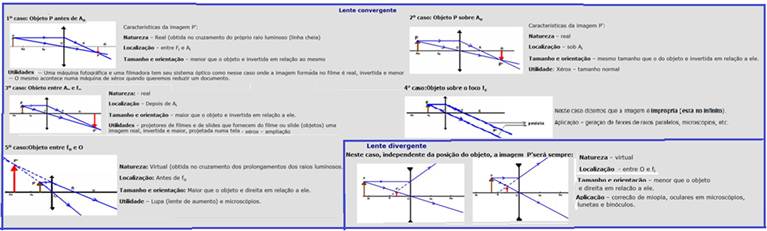
03- See the cases from the previous exercise and the figure below
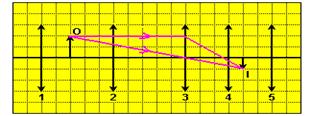
R-C
04- If the image is sharp and the object is very far away (at infinity, the light rays fall parallel to the main axis), the dashed line is over the focus of the lens (every light ray that falls parallel to the main axis passes through the lens, all of them passing through the focus) — note that in alternative B the image has the same size as the object and is inverted) — see in the cases of image construction in previous exercises that, in this case, the image is under the anti-principal point, at a distance equal to twice the focal length — R- B
05- As the lens is divergent, the extensions of the refracted rays must pass through F’
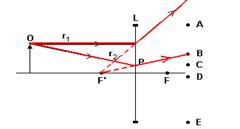
R-B
06- The lens is convergent (thin edges) and the object is between the focus and the lens and, tracing the rays
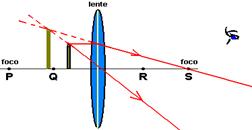
of light, the image will be closer to Q — R- B
07- I- This is a concave spherical mirror with the object between the focus and the mirror, which provides a virtual image, upright and larger than the object.
II- It is a convex spherical mirror that provides a virtual image, upright and smaller than the object.
III- It is a real image, as it is projected.
R-B
08- Lens L 1 — by tracing the notable light rays you determine the first image A’B’ (real,
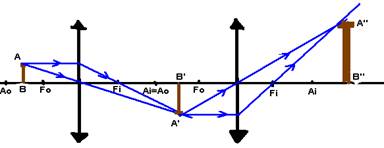
inverted and larger) provided by lens L 1 — this image A’B’ is now the object for the second lens L 2 — by tracing the new remarkable rays you determine the final image A”B” provided by lens L 2 and which is seen as being real, upright and larger in relation to the original object.
R-C