
Circular Motion (CM) – EN
Circular Motion (CM)
01-(ENEM-MEC)

Regarding the operation of a geared bicycle, where each gear is a combination

of one of the front chainrings with one of the rear chainrings, the following statements are made:
I. on a bicycle that has two front chainrings and five rear chainrings, we have a total of ten possible gears where each gear represents the association of one of the front chainrings with one of the rear chainrings.
II. at high speed, it is advisable to activate the front chainring with the largest radius with the rear chainring with the largest radius as well.
III. on a steep climb, it is advisable to activate the front chainring with the smallest radius and the rear chainring with the largest radius.
Among the previous statements, the following are correct:
a) I and III only.
b) I, II and III only.
c) I and II only.
d) II only.
e) III only.
02-(ENEM-MEC)

When the bicycle in the figure is pedaled (that is, when the crown actuated by the pedals makes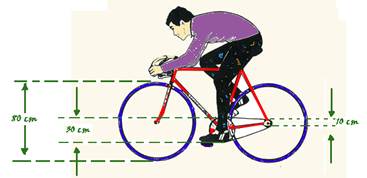
a complete lap), what is the approximate distance traveled by the bicycle, knowing that the length of a circle with radius R is equal to 2πR, where π ≈ 3?

03-(ENEM-MEC)

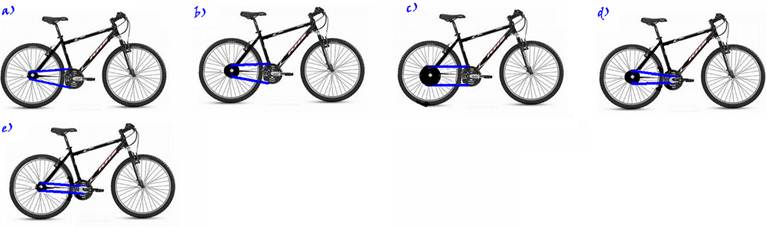
Bicycles have a chain that connects a front sprocket, moved by the pedals, to a sprocket located on the rear wheel axle, as shown in the figure.

The number of revolutions the rear wheel makes with each pedal stroke depends on the relative size of these chainrings.
In which of the following options does the rear wheel make the greatest number of revolutions per pedal stroke?
04-(ENEM-MEC)

05-(ENEM-MEC)

A telecommunications satellite, t minutes after reaching its orbit, is kilometers away from the center of the Earth.

When r assumes its maximum and minimum values, the satellite is said to have reached apogee and perigee, respectively. Suppose that, for this satellite, the value of r as a function of t is given by
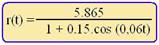
A scientist monitors the movement of this satellite to control its distance from the center of the Earth. To do this, he needs to calculate the sum of the values of r, at apogee and perigee, represented by S.
The scientist should conclude that, periodically, S reaches the value of
a) 12765 km.
b) 12000 km.
c) 11730 km.
d) 10965 km.
e) 5865 km.
Exercises with ENEM characteristics
06-(UNESP-SP)

Those on Earth always see the same side of the moon. This is because:

a) The Moon does not rotate or translate.
b) the Moon does not rotate, only translates.
c) the Moon’s rotation and translation periods are the same.
d) the opportunities to observe the dark side coincide with the Earth’s daytime period.
e) while the Moon revolves around the Earth, the Earth revolves around its axis.
07-(PUCCAMP-SP)

On a bicycle moving at constant speed, consider a point A on the periphery of the ratchet and a point B on the periphery of the wheel.

Analyze the statements:
I. The speed of A is equal to that of B.
II. The angular velocity of A is equal to that of B.
III. The period of A is equal to that of B.
ONLY what is stated in:

08-(UNIFESP-SP)

Father and son ride their bikes and go side by side at the same speed.

It is known that the diameter of the father’s bicycle wheels is twice the diameter of the son’s bicycle wheels. It can be said that the father’s bicycle wheels turn with
a) half the frequency and angular speed at which the son’s bicycle wheels rotate.
b) the same frequency and angular speed at which the wheels of the son’s bicycle rotate.
c) twice the frequency and angular speed at which the wheels of the son’s bicycle turn.
d) the same frequency as the son’s bicycle wheels, but with half the angular velocity.
e) the same frequency as the son’s bicycle wheels, but with twice the angular velocity.
09-(UEJF-MG)

A typical car speedometer actually measures the angular velocity of the wheel axle, and indicates a value that corresponds to the speed of the car. The speedometer for a given car starts from

factory calibrated for a 20-inch diameter wheel (this includes the tire). A driver decides to change the car’s wheels to 22-inch diameter. So, when the speedometer indicates 100 km/h, the car’s actual speed is:

10-(UNIFESP-SP)

Three bodies are at rest relative to the ground, located in three cities: Macapá, located on the Equator, São Paulo, on the Tropic of Capricorn, and Selekhard, in Russia, located on the Arctic Circle. It can be said that these three bodies rotate

around the Earth’s axis describing uniform circular movements, with
A) the same frequency and angular velocity, but the body located in Macapá has the highest tangential velocity.
B) the same frequency and angular velocity, but the body located in São Paulo has the highest tangential velocity.
C) the same frequency and angular velocity, but the body located in Selekhard has the highest tangential velocity.
D) the same frequency, angular velocity and tangential velocity, in any city.
E) frequency, angular velocity and tangential velocity are different from each other in each city.
11-(UFRJ-RJ)

The human eye retains the images formed on the retina for 1/24 of a second. This visual memory enabled the invention of cinema. The video camera takes 24 photographs (frames) per second.
Once developed, the film is projected at a rate of 24 frames per second. Thus, the next frame is projected at the exact moment that the previous frame is disappearing from our visual memory, which gives us the sensation of continuity.

A film is made of a fan whose blades are rotating in a clockwise direction. This fan has four symmetrically arranged blades, one of which is painted a different color. When the film is projected, the frames appear on the screen in a sequence that gives us the impression that the blades are rotating in an anti-clockwise direction.

Therefore, the minimum number of rotations per second that the blades must be making, for this to occur, is:
