
Hydrostatics – Resolution – EN
Commented Resolution
Hydrostatics
Hydrostatic Pressure
01- The pressure at the bottom of the reservoir due only to the liquid column P liquid = d liquid .gh is called hydrostatic depression and P = P atm + d liquid .gh is called total pressure, absolute pressure or simply pressure — the pressure exerted by a liquid column does not depend on the dimensions of the container that contains it, but only on the nature of the liquid, given by its density (d), the location (g) and the height of the column (h) — the graph of the total pressure P as a function of the height “depth” h, (P = P atm + dgh, “this expression is called the Fundamental Theorem of Hydrostatics or Stevin’s Theorem), which is a function of the first degree), is an inclined line — therefore, the pressure
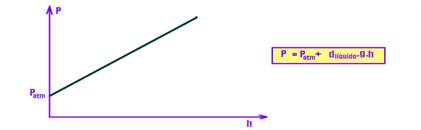
at the bottom of the container varies linearly with height and is independent of the cross-sectional area of each cylinder — R- A
02- When you open the valve, water flows from the left tank to the right tank until they are the same height — the height of the water in the left tank decreases and consequently the pressure at the base of the tank also decreases — A- A
03- Stevin’s theorem — P= P atm + dgh — 4.10 5 = 10 5 + 10 3 .10.h — h=3.10 5 /10 4 — h=30m — to undergo a pressure variation ΔP=10 4 N/m 2 in the vertical ascent , in Δt=1s, it must move — ΔP=dgh — 10 4 =10 3 .10.h — h=1m — V= ∆S/∆t — V=Δh/Δt — V=1/1 — V=1m/s — R- D
04- The pressure of the air trapped in the boat at depth h=(2.20 – 1.70)=0.5m is given by P= P atm + dgh — P – P atm = dgh = 10 3 .10.0.5 — P – P atm =5.0.10 3 N/m 2 — R- A
05- The force of the water jet from the flush causes the water to flow quickly through the siphon, taking the waste away — then, the water returns to the same height in the siphon and in the toilet, as both are subject to the same pressure (same principle as communicating toilets), keeping the water level constant and preventing the smell of sewage from invading the bathroom —
A- A
06- According to Stevin’s Theorem, points of the same liquid at rest that are on the same horizontal are under the same pressure — so, at point A on the horizontal that passes through the interface between the water and the denser liquid, the pressure must be the same as at point B.
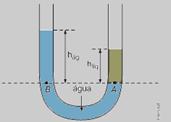
situated in water, on the same horizontal — p A = p B — d water .gh water =d liquid .g . .h liquid — as d liquid > d water (exercise data) —h liquid < h water — R- D
07- Data — d water = 1 g/cm 3 = 10 3 kg/m 3 ; — d glucose = 1.3 g/cm 3 = 1.3.10 3 kg/m 3 — h water = 10 cm = 10 -1 m; h glyc = 1 m — g = 10 m/s 2 — p atm = 1.01.10 5 Pa — pressure of the water column — P water = d water .gh water =(10 3 ).10.(10 -1 ) — P water =1.0.10 3 Pa=0.01.10 5 Pa — pressure of the glycerin column — P glyc = d glyc .gh glyc =(1.3.10 3 ).(10).(1) — P glyc =1.3.10 4 Pa=0.13.10 5 Pa — on the surface separating water-glycerin the pressure is P 1 = P atm + P water =1.01.10 5 + 0.01.10 5 — P 1 =1.02.10 5 Pa — at the bottom of the container, the pressure is (p 2 ) and is worth — P 2 = P atm + P water + P glyc — P 2 = 1.01.10 5 + 0.01.10 5 + 0.13.10 5 — P 2 = 1.15.10 5 Pa. — R- E
Note: according to the International System of Units, the plural of units is formed by simply adding the letter s at the end, when it does not end in s. If it ends in s, it does not undergo inflection, and when written in full, it must be in lowercase letters. Examples: pascal – pascals; decibel – decibels; newton – newtons.
08- Data: m = 900 kg; A 1 = 2,500 cm 2 = 25.10 -2 m 2 ; A 2 = 25 cm 2 = 25.10 -4 m 2 ; d oil = 900 kg/m 3 ; h = 4m — according to Stevin’s theorem, points of the same liquid at rest that are in the
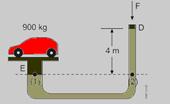
same horizontal support the same pressure — the pressure at point (1) caused by the weight of the car is equal to the pressure at point (2) caused by the force  , added to the pressure of the liquid column — P r1 = P r2 — W eigh of car / A 1 = F / A 2 + d ´ oleo .gh — 9000 / 25.10 -2 = F / 25.10 -4 + 900.10.4 — 36,000 – 36,000 = F / 25.10 -4 — F = 0 — R – A
09- The difference in hydrostatic pressure (ΔP) between two points of unevenness h, for a liquid of density d líq , is given by Stevin’s theorem — ΔP = d líq .gh — thus, this difference only depends on the density of the liquid, the unevenness h and the local gravity g — R- B
10- Data — h = 2,000 m — g = 10 m/s 2 — ρ = 0.9 g/cm 3 = 0.9.10 3 =9.10 2 kg/m 3 — Stevin’s theorem — ∆P = ρ g h =9.10 2 .10.2.10 3 — ∆P = 180.10 5 — ∆P = 1.8.10 7 Pa — R- B