
Characteristics of Series-Parallel Associations – Resolution – EN
CHARACTERISTICS OF SERIES-PARALLEL ASSOCIATIONS – RESOLUTION
Commented Resolution
Characteristics of Series-Parallel Associations
01-(ENEM-MEC)
Calculation of the electric current i of each fuse using the nominal values P=iU — i=55/36 A — when connected to the same fuse, the new current i’ passes through the two lamps, each of
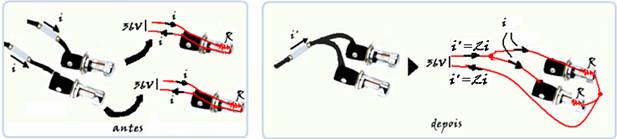
resistance R, are associated in parallel and, in this case, the equivalent resistor is worth Req=R/2 — if the equivalent resistance drops by half, the new current i’ is equal to twice the previous one, since, R=U/i with constant U — or, both lamps are working within specifications and therefore run by current i=55/36 A — i’=2.(55/36) — i’=3.05 A — to support this electric current, the lowest value of the fuse must be 5 A, that is, orange — R-C
02-(FATEC-SP)
Equivalent resistance of m resistors of electrical resistance R1 — Req1=mR1 — idem — Req2=nR2 — Reqtotal=mR1 + nR2 — the current is the same in all resistors (series association) and is worth — Reqtotal=U/i — (mR1 + nR2)=U/i — i=U/(mR1 +nR2) — R- A
03-(CEFET-RJ)
The total voltage is the sum of the voltages of each lamp — U t = nU l — 117 = n.15 — n = 117/15 — n = 7.8 — as the voltage at the terminals of each lamp cannot exceed 15V, 8 lamps must be selected — R- D
04-(FUVEST-SP)
Closing switch C causes a short circuit in the terminals of lamp A, the current diverts and it goes out. Thus, as the total resistance decreases, the current increases in lamp B, increasing its brightness.
A- A
05-(UNIFESP-SP)
Power supplied by the battery — Pb=iU=330.10-3.6 — Pb=1.98W — as the LED consumes a power of 1.0W, there is a power left for the resistor R of 1.98 – 1.0 — PR=0.98W — PR=Ri 2 —0.98=R.(330.10 -3 ) 2 — R=98.10 -2 /(33.10 -2 ) 2 — R=9.0Ω — R- C
06-(PUC-SP)
Correct answer — circuit in figure III where you can turn on the lamp, independently, with any of the switches — observe the sequence below:
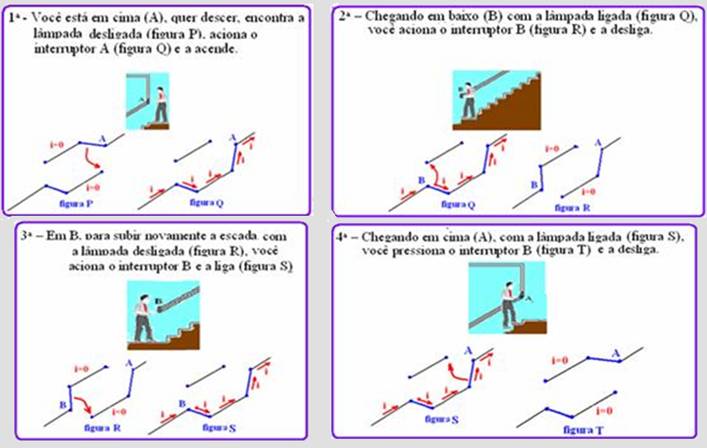
R-C.
07-(FGV-SP)
I- False — when one of the bulbs burns out, in the series circuit, the electric current is interrupted and the other bulb goes out.
II- False — as the lamps are identical, each one will be subject to a voltage of 110V and the power in each one will be 4 times lower, that is, 25W.
III- False — as the lamps are identical and each of them will be subject to a voltage of 110V, they will be within specifications and functioning normally.
IV- Correct — as they are identical, each of them will have half of the total voltage, which is 220V, that is, each one will be subject to a voltage of 110V.
R-B
08-(PUC-SP)
Series — R1 + R2=6 — R1=6 – R2 — parallel — R1.R2/(R1 + R2)=4/3 — (6 – R2).R2=(6 – R2 + R2) — R2 2 – 6R2 + 8=0 — √Δ=2 — R2=(6 ± 2)/2 — R’2=4Ω — R”=2Ω — when one is 2Ω, the other is 4Ω and vice versa — R- C
09-(UFPE-PE)
R and the lamp are in parallel and both under ddp of 12V — lamp — P=iU — 6=il.12 — il=0.5A — Rl=U/i=12/0.5 — Rl=24Ω — Req= 24R/(24 + R) — Req=U/i — 24R/(24 + R)=12/3 — 20R=96 — R=4.8Ω — R- E
10-(UCS-RS)
The upper wire corresponds to one of the poles (phases) of the source and the lower one to the other — observe the figures carefully — R- E
11-(FUVEST-SP)
Current in the lamp — Pl=il.U — 150=il.110 — il=214/15A — current in the iron — as the lamp and iron are associated in parallel — idisbreaker=il + if — if=(15 – 214/15) — if=214/15A — Pf=if.U — Pf=214/15.110=1,570W — R- B
Back to exercises