
Electric field – EN Resolution
ELECTRIC FIELD – RESOLUTION
Entrance exam exercises with commented solutions on
Electric field
01-(FUVEST-SP) At a point in space:
I. An electric charge is not acted upon by the electric force if the field at that location is zero.
II. An electric field can exist without there being an electric force.
III. Whenever there is an electrical charge, it will be acted upon by electrical force.
Use: C (right) or E (wrong).

02-(UFU-MG) The figure below represents a charge Q and a point P of its electric field, where it is
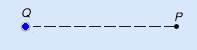
a test charge q is placed. Analyze the statements below, observing whether they correctly represent the point of action and the direction of the electric field vector at P and the force
 acting on q. The following are correct:
a) all statements.
b) only I, II and III.
c) only II, III and IV.
d) only III and IV.
e) only I and III.
03-(FATEC-SP) At a point P in space there is a  horizontal electric field of intensity E=5.104N/C, facing to the right.
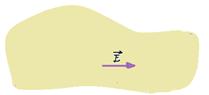
a) If a positive test charge of 1.5μC is placed at P, what will be the value of the electric force acting on it?
b) In which direction will the test charge tend to move if it is released?
c) Answer questions a and b assuming that the test charge is negative.
04-(UFB) How can you detect the presence of an electric field in a certain region of space?
05-(FATEC-SP) A charge q = 2.0.10 -6 C is placed at a point M in space and is subject to an electric force F = 10N, for the
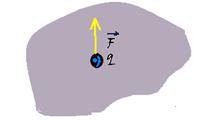
north. At this point, calculate the intensity and direction of the electric field.
06-(MACKENZIE-SP) A point electric charge with 4μC that is placed at a point P in a vacuum is subject to an electric force of intensity 1.2 N. The electric field at that point P has an intensity of: Consider K=9.10 9 N.m 2 /C 2
a) 3.0.105 N /C
b) 2.4.10 5 N/C
c) 1.2.10 5 N/C
d) 4.0.10 -6 N/C
e) 4.8.10 -6 N/C
07-(UFRGS-RS) The magnitude of the electric field vector produced by a point electric charge at a point P is equal to E. By doubling the distance between the charge and point P, by moving the charge away, the magnitude of the electric field vector at that point changes to:
a) E/4. b) E/2. c) 2E. d) 4E. e) 8E.
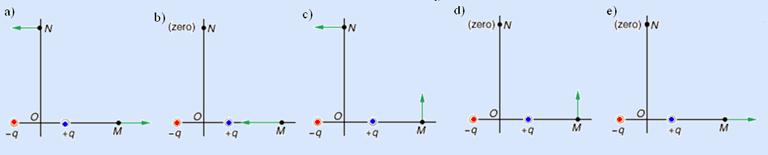
08-(UERJ-RJ) Two point charges are located d apart from each other. Consider the two points M and N (see figure). Such that OM = ON. Which of the following figures correctly represents the electric field vector at M and N?
=
09-(UFPI) A test charge q, placed at a point in an electric field E=2.0.10 3 N/C, is acted upon by a force F=18.10 -5 N. The value of this charge, in coulombs, is:

10-(UCBA) Which of the following graphs best represents the magnitude of the electric field as a function of the distance d to the generating point electric charge?

11-(UFB) At a point A in a region, the intensity of the electric field is E=5N/C, with direction and sense indicated in the figure.
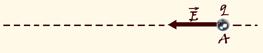
Determine the intensity, direction and sense of the electric force acting on a test charge with module │q│=3μC, placed at this point, considering:
a) q>0
b) q<0
12-(FEI-SP) Consider the figure below, where  is the resulting electric field vector in A , generated by the fixed charges Q 1 and Q 2 and
  is the electric force on the test charge q, placed in A.
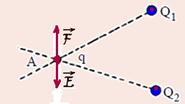
Given the alternatives below, select the correct one:
a) Q1 < 0, Q2 > 0 and q < 0
b) Q1 > 0, Q2 < 0 and q > 0
c) Q1 > 0, Q2 > 0 and q < 0
d) Q1 > 0, Q2 < 0 and q < 0
e) Q1 < 0, Q2 < 0 and q > 0
13-(PUC-MG) The figure represents two fixed, positive electric charges, where q 1 > q 2 .

The electric field vectors, due to the two charges, at the midpoint M of the distance between them, are best represented in:

14-(UFMG-MG) A point P is located at the same distance from two charges, one positive and one negative, of the same magnitude. The option that correctly represents the direction and sense of the electric field created by these charges, at point P, is:

15-(MACKENZIE –SP) Consider the figure below:
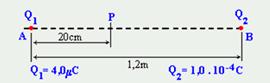
The two point electric charges Q 1 and Q 2 are fixed, in a vacuum, where K o = 9.0 . 10 9 N.m 2 C 2 , respectively, on points A and B. The resulting electric field at point P has intensity:

16-(UCSal-BA) The points marked in the figure below are equally spaced:

The resulting electric field vector, created by Q and –4Q, located at points 7 and 4 indicated in the figure, is zero at the point:

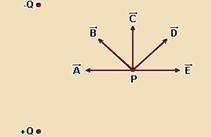
17-(UNESP-SP) In the figure below, point P is equidistant from the fixed charges +Q and -Q. Which of the vectors indicates the direction of the electric field at P, due to these charges?

18-(CESGRANRIO-RJ) Four electric charges, three positive and one negative, are placed at the vertices of a square,
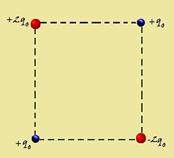
as shown in the figure.
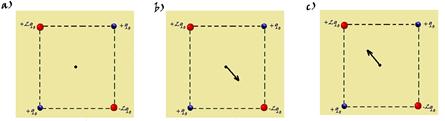
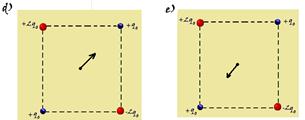
19-(UFB) The following figure shows two points P and N, and the respective electric field vectors in a region where the electric field was created by a single fixed point charge Q.
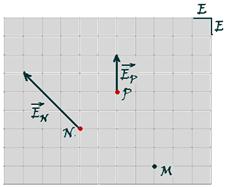
Based on the scale figure E=2.10 3 N/C:
a) Locate the charge Q, which originates the field, and determine its sign.
b) Determine the intensity, direction and sense of the electric force acting on a test charge q=3μC placed at point M.
20-(UERJ-RJ) Two point electric charges, of the same value and opposite signs, are found at two of the vertices of an equilateral triangle. At the midpoint between these two vertices, the magnitude of the resulting electric field due to the two charges is E. What is the magnitude of the electric field at the third vertex of the triangle?

21-(FUVEST-SP) A small sphere, with positive electric charge Q = 1.5 × 10 -9 C, is at a height D = 0.05 m above the surface of a large conductive plate, connected to the Earth, inducing negative charges on this surface, as in figure 1. The set of these charges establishes an electric field that is identical, only in the part of the space above the plate, to the field generated by a charge +Q and a charge -Q, as if it were an “image” of Q that was placed in the position represented in figure 2.
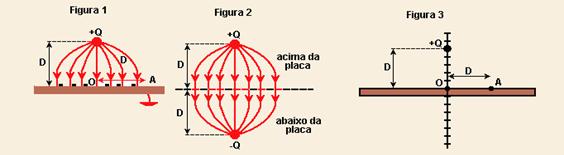
a) Determine the intensity of the force F, in N, acting on the charge +Q, due to the charges induced in the plate.
b) Determine the intensity of the electric field E o , in V/m, that the negative charges induced in the plate create at the point where the charge +Q is located.
c) Represent, in the diagram in figure 3, at point A, the electric field vectors E + and E – , caused, respectively, by the charge +Q and the charges induced in the plate, as well as the resulting field, E A . Point A is at a distance D from point O in the figure and very close to the plate, but above it.
d) Determine the intensity of the resulting electric field E A , in V/m, at point A.
22-(PUC-SP) Three charges are placed at the vertex of an equilateral triangle, as shown in the figure.
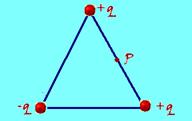
The resulting electric field vector created by the charges at point P is best represented by:

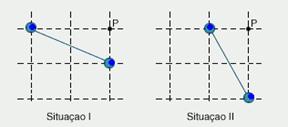
23-(FUVEST-SP) Two small spheres, with equal electric charges connected by an insulating bar, are initially placed as described in situation I. Then, one of the spheres is brought closer to P, reducing its distance to that point by half, while doubling the distance between the other sphere and P, as in situation II. The electric field at P, in the plane containing the center of the two spheres, has, in both situations indicated:
a) same direction and intensity.
b) different directions and same intensity.
c) same direction and greater intensity in I.
d) different directions and greater intensity in I.
e) different directions and greater intensity in II.
24-(PUC-SP) Characterize the electric field capable of balancing a drop of water in the air, close to the ground.

oil of mass 4.10 -10 g and charge q = +10 e (e = 1.6.10 -19 C). (g = 10 m/s 2 )
25-(UFPE) Three point charges with a value of Q = 10 -6 C were positioned on a circumference with a radius of 1 cm, forming
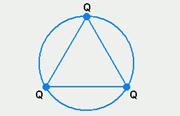
an equilateral triangle, as shown in the figure. Determine the magnitude of the electric field at the center of the circle, in N/C.
26-(PUC-RJ) Two metal spheres containing charges Q and 2Q are separated by a distance of 1.0 m. We can say that, halfway between the spheres, the electric field generated by:
a) both spheres are equal.
b) one sphere is 1/2 of the field generated by the other sphere.
c) one sphere is 1/3 of the field generated by the other sphere.
d) one sphere is 1/4 of the field generated by the other sphere.
e) both spheres are equal to zero.
27-(UFRS-RS) Three point charges, with values +2Q, +Q and -2Q are located at three vertices
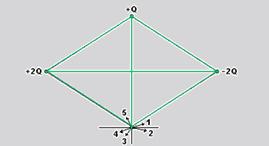
of a rhombus, as shown in the following figure. Knowing that there are no other electric charges present in the vicinity of this system, which of the arrows shown in the figure best represents the electric field at point P, the fourth vertex of the rhombus?
a) Arrow 1.
b) Arrow 2.
c) Arrow 3.
d) Arrow 4.
e) Arrow 5.
28-(UEPG) A point electric charge Q generates an electric field in a certain region of space. Considering a point P at a distance r from the charge Q, mark the correct one.
(01) The intensity of the electric force vector acting on the test charge q o is inversely proportional to the intensity of the electric field vector.
(02) The direction of the electric field vector is that of the electric force vector that acts on the test charge q o , placed at point P, if q o > 0..
(04) The intensity of the electric field vector is inversely proportional to the square of the distance r.
(08) The electric field will be zero at point P if the test charge q has a sign opposite to that of the charge Q.
(16) If the direction of the electric field vector is away from the charge Q, then the test charge qo has a sign opposite to that of the charge Q.
29-(UFRJ-RJ) Two point charges q 1 = 2.0.10 -6 C and q 2 = 1.0.10 -6 C are fixed on a plane in the positions given by the Cartesian coordinates indicated below. Consider K = 9.0.10 9 NC -2 m 2 .
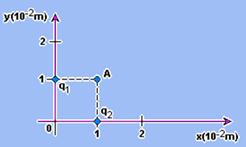
Calculate the electric field vector at position A indicated in the figure, explaining its module, direction and sense.
30-(FUVEST-SP) A small object with a positive electric charge is dropped from the top of an inclined plane at point A and slides without being deflected until it reaches point P. Four small disks with electric charges of the same magnitude are fixed to the plane. The figures represent the disks and the signs of the charges, seen from above. Of the following configurations, the only one compatible with the rectilinear trajectory of the object is

31-(FUVEST-SP) The diagram in the following figure represents the intensity of the electric field generated by a fixed point charge in a vacuum, as a function of the distance d to the charge. (Consider K=9.0.10 9 Nm 2 C 2 )
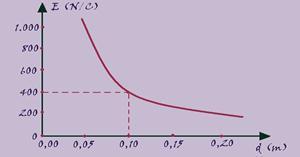
a) Calculate the value of the charge Q that creates the field.
b) Determine the intensity of the electric field at a point 30 cm away from the fixed charge.
32-(UEFS-BA) Suppose an electrically charged particle is placed at rest in a region of space where there is a
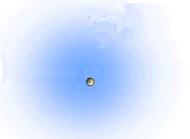
uniform electric field and where the gravitational field is negligible. This particle will:
a) remain at rest
b) acquire a constant speed
c) acquire a constant acceleration
d) acquire a circular motion
e) acquire a parabolic movement.
33-(UFPEL-RS) The positron and the antiparticle of the electron have the same mass but with a positive electric charge +e. Under the action of a uniform electric field, the positron undergoes an acceleration whose module is a .
By quadrupling the intensity of the electric field, the positron will undergo an acceleration whose magnitude is
a) a/2 b) a c) a/4 d) 4a e) 3a
34-(MACKENZIESP) A corpuscle with a negative electric charge is left from rest inside a uniform electric field generated by two metal plates , parallel to each other and charged with equal charges of different signs . The movement acquired by this corpuscle , in relation to the plates , is :
a) rectilinear and uniform. b) rectilinear uniformly retarded. c) rectilinear uniformly accelerated.
d) uniform circular . e) accelerated with a parabolic trajectory .
35-(MACKENZIE-SP) There is an electric field pointing downwards, in the Earth’s atmosphere,
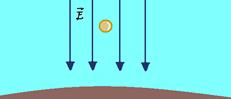
with an average intensity of 100 N/C. It is desired to float a 0.5 kg sulfur sphere in this field. What charge (module and sign) does the sphere need to have? (g=10m/s2 ) .
36-(UFV-MG) In a variable electric field oriented downwards, an electron is incident,
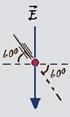
at an angle of 60 ° to the horizontal. Disregarding the action of gravity, it can be stated that the electric force acting on the electron:
a) makes an angle of 0 ° with the horizontal.
b) has the direction and sense of the electric field
c) makes an angle of 90 ° with the horizontal
d) is perpendicular to the electron velocity vector
e) has the direction and sense of the electron’s speed.
37-(UFG-GO) Materials in general are made up of electrical charges, and may be

neutral or positively or negatively charged. Regarding the behavior of these materials, from an electrostatic point of view, it is correct to state that:
01. an electrically neutral body, suspended by an insulating wire, is repelled when we bring a positively charged rod closer to it;
02. a charge Q creates an electric field in the space around it, and this field is responsible for the appearance of electric force in other charges, placed in the space around it;
04. the electric charge in a spherical conductive shell is distributed on its internal surface, canceling out the electric field in the vicinity of the external surface;
08. the electrostatic force that a charge q 1 exerts on a charge q 2 is directly proportional to the distance that separates their centers.
38-(UFF- RJ) Between two metal plates, parallel and L apart, there is a field
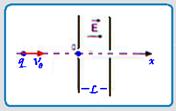
uniform electric current  , as shown in the figure. Through two small holes, a positive charge passes through the system, having an initial velocity V o .
Indicate which of the following options best represents the variation in the speed of the load as a function of its position along the x-axis. 
39-(UFMG-MG) In the figure, an electron moves in the x direction, with initial velocity  . Between the points x 1 and x 2 , there is a uniform electric field, whose lines of force are also represented in the figure.
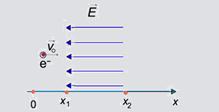
Neglect the weight of the electron in this situation. Considering the situation described, select the alternative whose graph best describes the electron’s velocity module as a function of its position x.

40-(FUVEST-SP) An F source emits particles (electrons, protons and neutrons) that are launched into the
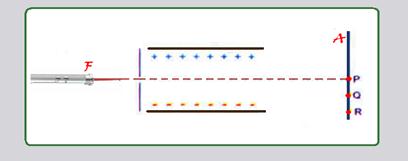
inside a region where there is a uniform electric field. The particles penetrate perpendicular to the lines of force of the field. Three emitted particles hit the screen A at points P, Q and R. We can state that these particles were, respectively:
a) electron, neutron, proton
b) proton, neutron, electron
c) electron, proton, proton
d) neutron, electron, electron
e) neutron, proton, proton
41-(UFMG-MG) The figure shows, schematically, the main parts of an inkjet printer.
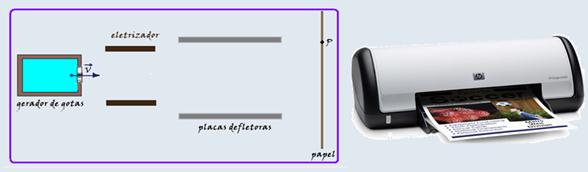
During the printing process, an electric field is applied to deflect the electrified drops. In this way, the drops fall exactly on the programmed spot on the sheet of paper where, for example, part of a letter will be formed. Consider that the drops are negatively electrified. For them to reach point P in the figure, the electric field vector between the deflector plates is best represented by:

42-(UNICAMP-SP) An electron is accelerated, from rest, along 8.8 mm, by a constant and uniform electric field of module E = 1.0.10 5 V/m. Knowing that the charge/mass ratio of the electron is e/m = 1.76.10 11 C/kg, calculate:
a) the acceleration of the electron.
b) the final velocity of the electron.
c) Upon leaving the electric field, the electron penetrates perpendicularly to a constant and uniform magnetic field with module B = 1.0 × 10 -2 T. What is the radius of the orbit described by the electron?
43-(UNESP-SP) A device for measuring the electrical charge of a drop of oil consists of a
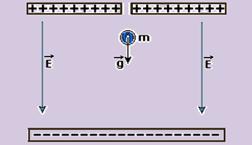
polarized capacitor inside a suitably sealed container, as illustrated in the figure. The oil drop, with mass m, is released from rest inside the capacitor, where there is a uniform electric field E. Under the action of gravity and the electric field, the drop begins a falling motion with an acceleration of 0.2 g, where g is the acceleration of gravity. The absolute value (module) of the charge can be calculated using the expression
a) Q = 0.8 mg/E.
b) Q = 1.2 E/mg.
c) Q = 1.2 m/gE.
d) Q = 1.2 mg/E.
e) Q = 0.8 E/mg.
44-(PUC-MG) At the beginning of the 20th century (1910), the North American scientist ROBERT MILLIKAN managed to determine the value of the electric charge of the ELECTRON as q = -1.6.10 -19 C. To do this, he placed electrified oil droplets inside a vertical electric field, formed by two electrically charged plates, similar to a capacitor with flat and parallel plates, connected to a voltage source as shown in the illustration below (g = 10 m/s 2 ).
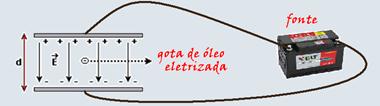
Assuming that each droplet has a mass of 1.6.10 -25 kg, indicate the value of the electric field necessary to balance each drop, considering that it has the surplus of a single ELECTRON (elementary charge).

45-(FUVEST-SP) A particle with charge q > 0 and mass m, with velocity v o > 0, penetrates a region of space, between x = 0 and x = a, in which there is only a uniform electric field, E > 0 (see figure). The field is zero for x < 0 and x > a. Neglect gravitational actions.
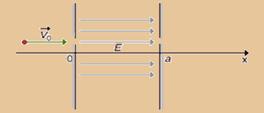
a) What is the acceleration between x = 0 and x = a?
b) What is the velocity for x > a?
46-(UNICAMP-SP) Consider a sphere of mass m and charge q hanging from the ceiling and under the action of gravity and the electric field.
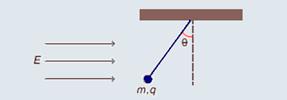
And as indicated in the figure.
a) What is the sign of the charge q? Justify your answer.
b) What is the value of the angle θ at equilibrium?
47-(FUVEST-SP) A certain pendulum clock consists of a small ball, with mass M = 0.1 kg, which oscillates attached to a string. The time interval that the ball takes to, starting from position A, return to that same position is its period T o , which is equal to
2 s. In this clock, the minute hand completes one revolution (1 h) every 1800 complete oscillations of the pendulum. If the clock is in a region where a constant and homogeneous electric field E acts, and the ball is charged with electric charge Q, its period will change, becoming T Q . Consider the situation in which the ball is charged with charge Q = 3.10 -5 C, in the presence of an electric field whose magnitude E = 1.10 5 V/m.
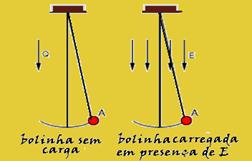
So, determine:
a) the intensity of the effective force Fe, in N, acting on the charged ball.
b) the ratio R = T Q /T o between the periods of the pendulum, when the ball is charged and when it has no charge.
c) the time that the clock will be indicating, when it is in fact 3 p.m., for the situation in which the electric field has started to act since noon.
48-(UFMS-MS) The wind moves a charged cloud with a constant horizontal velocity V, close to the Earth’s surface (see figure). The cloud is negatively charged with a uniform distribution of charges. Suppose that, due to the evaporation of water, water molecules are floating close to the Earth’s surface. Since the center of positive charges of the two hydrogen atoms does not coincide with the center of negative charges of the oxygen atom that constitutes each water molecule, we can consider each water molecule as an electric dipole with charges +2e and -2e, where e is the charge of the electron. These dipoles are initially at rest and with random orientations. Always consider the gravitational field, produced by the Earth, and the electric field, produced by the cloud, to be uniform. Regarding the physical phenomena that will occur when the cloud passes over the dipoles, mark the correct alternative.
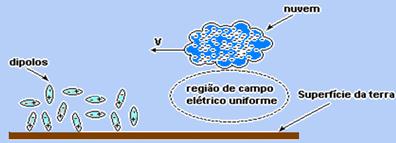
a) The vector that represents the electric field produced by the cloud will have a direction from the cloud to the Earth’s surface.
b) The dipoles will be aligned by the electric field, attracted and dragged to the cloud.
c) The resulting electric force on each dipole will be zero.
d) During the alignment of the dipoles, the electric force does not do work on the dipoles.
e) The dipoles will be aligned predominantly in the horizontal direction.
49-(UEL-PR) Scientific magazines help the general public to learn more about Physics. However, some basic concepts often need to be understood in order to understand the information. This text explains two important elementary concepts for understanding the information provided: electric field and electric current.
Select the alternative that correctly defines the electric field.
a) The electric field is a vector quantity defined as the ratio between the electric force and the electric charge.
b) The electric field lines of force converge towards the positive charge and diverge towards the negative charge.
c) The electric field is a scalar quantity defined as the ratio between the electric force and the electric charge.
d) The intensity of the electric field inside any closed conducting surface depends on the geometry of this surface.
e) The direction of the electric field is independent of the sign of the charge Q, which generates the field.
50-(UFC-CE) A particle of mass m and positive charge q, with horizontal velocity  (module v), penetrates a region of length L (parallel to the initial velocity of the particle), in which there is a vertical electric field
  (constant), as shown in the following figure. The local acceleration of gravity is (of module g, vertical direction and downwards).
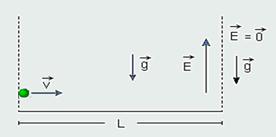
In the region where the electric field is non-zero (between the dashed vertical lines in the figure below), the electric force has a magnitude greater than the gravity force. Determine the magnitude of the electric field for which the particle has the maximum range along the horizontal line located at the height at which it leaves the region of the electric field. Neglect any energy dissipation effects (air resistance, friction, etc.).
51-(UNICAMP-SP) The fact that atomic nuclei are formed by protons and neutrons raises the question
question of nuclear cohesion, since protons, which have a positive charge q = 1.6.10 -19 C , repel each other through the electrostatic force. In 1935, H. Yukawa proposed a theory for the strong nuclear force, which acts at short distances and keeps nuclei cohesive.
a) Consider that the magnitude of the strong nuclear force between two protons FN is equal to twenty times the magnitude of the electrostatic force between them F E , that is, FN = 20 F E . The magnitude of the electrostatic force between two protons separated by a distance d is given by F E = K(q 2 /d 2 ), where K = 9.0.10 9 Nm 2 /C 2 . Obtain the magnitude of the strong nuclear force FN between the two protons, when separated by a distance = 1.6.10 -15 m, which is a typical distance between protons in the nucleus.
b) Nuclear forces are much greater than the forces that accelerate particles in large
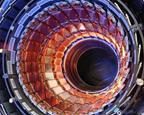
accelerators such as the LHC. In a first stage of the accelerator, charged particles move under the action of an electric field applied in the direction of motion. Knowing that an electric field of magnitude E = 2.0.10 5 N/C acts on a proton in an accelerator, calculate the electrostatic force acting on the proton.
52-(FUVEST-SP) An insulating bar has four slots, in which electric charges of the same magnitude are placed, the positive ones being in the light slots and the negative ones in the dark slots. At a certain distance from the bar, the direction of the electric field is indicated in figure 1. A frame was built with four of these bars, forming a square, as represented in figure 2. If a positive charge is placed in the center P of the frame, the electric force that will act on the charge will have its direction and sense indicated by:
Disregard any effects of induced loads.

53-(FUVEST-SP) A uniform electric field, of magnitude E, created between two large parallel charged plates, P 1 and P 2 , is used to estimate the charge present in small spheres. The spheres are fixed to the end of a rigid and very light insulating rod, which can rotate around point O. When a small sphere A, of mass M = 0.015 kg and charge Q, is fixed to the rod, and with E equal to 500 kV/m, the sphere assumes an equilibrium position, such that the rod forms
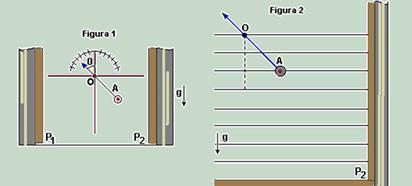
with the vertical an angle θ = 45°. For this situation:
a) Represent the gravitational force P and the electric force F that act on sphere A when it is in equilibrium under the action of the electric field. Determine the modules of these forces, in newtons.
b) Estimate the charge Q, in coulombs, present in the sphere.
c) If the sphere were to detach itself from the rod, represent, in figure 2, the path it would follow, indicating it with the letter T.
54-(ITA-SP) A negatively charged particle is moving in the +x direction when it enters a uniform electric field acting in that same direction and sense. Considering that its position at t = 0 s is x = 0 m, which graph best represents the particle’s position as a function of time during the first second?

55-(UEG-GO) Regarding the concepts of scalar fields and vector fields, answer what is asked.
a) An object with mass m and charge q at rest generates which field(s)? Justify.
b) An object with mass m and charge q in motion generates which field(s)? Are these field(s) vector or scalar? Justify.
56-(PUC-PR) There is currently great interest in reducing the environmental impacts caused by agriculture through research, methods and equipment. However, the application of pesticides continues to be extremely wasteful of energy and chemicals. The increasing costs of inputs, labor, energy and the growing concern regarding environmental contamination have highlighted the need for more appropriate technology for placing pesticides on targets, as well as procedures and equipment that lead to greater worker protection. In this context, the use of drops with electrical charges, electrified using electrostatic nozzles, has shown promise, since when a cloud of these particles approaches a plant, the phenomenon of induction occurs, and the surface of the plant acquires electrical charges of opposite sign to that of the drops. As a consequence, the plant strongly attracts the drops, promoting an improvement in deposition, including on the underside of the leaves.
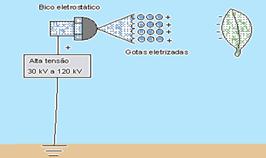

Based on the analysis of the information, it is CORRECT to state:
a) The drops can be neutral and the process will happen in the same way.
b) The induction phenomenon described in the text is characterized by the polarization of plant leaves, inducing a signal equal to that of the droplet charge.
c) The closer the drops and leaf are, the smaller the force of attraction will be.
d) Another important phenomenon arises with the mutual repulsion between the drops after leaving the nozzle: because they have the same charge, they repel each other, which contributes to an improvement in the distribution of the pesticide on the leaves.
e) There is an electric field in the direction from the leaf to the drops.
57-(ITA-SP)
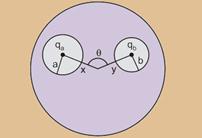
A conducting sphere of radius R has two spherical cavities inside it, of radius a and b, respectively, as shown in the figure. In the center of one cavity there is a point charge q a and in the center of the other, a point charge q b , each at a distance from the center of the conducting sphere of x and y, respectively. It is correct to state that
a) the force between charges q a and q b is k0qaqb/(x 2 + y 2 – 2xy cos θ).
b) the force between the charges q a and q b is zero.
c) it is not possible to determine the force between the charges, as there is not enough data.
d) if there were a third charge, q c , near the conductor , it would not feel any force. e) if there were a third charge, q c , near the conductor , the force between q a and q b would be altered.
58-(FATEC-SP) Read the following text.
Technique allows recycling of printed circuit boards and recovery of metals
Electronic circuits in computers, cell phones and other equipment can now be

recycled in a less environmentally harmful way thanks to a technique that involves grinding printed circuit boards.
The ground material is subjected to a high voltage electric field to separate the metallic materials from the non-metallic ones, as the huge difference between the electrical conductivity of the two types of materials allows them to be separated.
(http://www.inovacaotecnologica.com.br/noticias/noticia.php?artigo=010125070306, accessed on 04.09.2009. Adapted.)
Considering the information in the text and the physical concepts, it can be stated that the components
a) metallic, subjected to the electric field, suffer less action from it because they have greater electrical conductivity.
b) metallic materials, subjected to the electric field, suffer greater action from it because they have greater electrical conductivity.
c) metallic, subjected to the electric field, suffer less action from it because they have lower electrical conductivity.
d) non-metallic materials, subjected to the electric field, suffer greater action from it because they have greater electrical conductivity.
e) non-metallic, subjected to the electric field, suffer less action from it because they have greater electrical conductivity.
59-(CFT-MG) Four point charges of the same value +q are placed at the vertices of a square with side L.
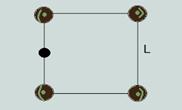
The resulting electric field vector at the center of the side marked with  is
is

60-(UECE-CE) What is the effect on the electric force between two charges q 1 and q 2 when an insulating, isotropic and homogeneous medium is placed between them?
a) None, because the added medium is insulating.
b) The force increases due to charges induced in the insulating material.
c) The force decreases due to charges induced in the insulating material.
d) None, because the charges q 1 and q 2 do not change.
61-(UEL-PR) “Clouds, lightning and thunder were perhaps among the first natural phenomena observed by prehistoric humans.

prehistoric. […]. The precipitative theory is capable of conveniently explaining the basic aspects of cloud electrification, through two processes […]. In the first of these, the existence of the atmospheric electric field directed downwards […]. Lightning is a short-duration discharge, with intense electric currents, which propagate over distances of the order of kilometers […]”.
(FERNANDES, WA; PINTO Jr. O; PINTO, IRCA Electricity and air pollution. Science Today. v. 42, n. 252. Sep. 2008. p. 18.)
Scientific magazines help the general public to learn more about Physics. However, some basic concepts often need to be understood in order to understand the information. This text explains two important elementary concepts for understanding the information provided: electric field and electric current.
Select the alternative that correctly defines the electric field.
a) The electric field is a vector quantity defined as the ratio between the electric force and the electric charge.
b) The electric field lines of force converge towards the positive charge and diverge towards the negative charge.
c) The electric field is a scalar quantity defined as the ratio between the electric force and the electric charge.
d) The intensity of the electric field inside any closed conducting surface depends on the geometry of this surface.
e) The direction of the electric field is independent of the sign of the charge Q, which generates the field.
62-(CESGRANRIO-RJ) A three-dimensional system of orthogonal coordinates, graduated in meters, is in a medium whose electrostatic constant is 1.3.10 9 Nm 2 /C 2 . In this medium, there are only three positive point charges Q 1 , Q 2 and Q 3 , all with a charge equal to 1.44  10 –4 C.
These charges are fixed, respectively, at the points (0,b,c), (a,0,c) and (a,b,0). The numbers a, b and c (c < a < b) are the roots of the equation x 3 – 19x 2 + 96x – 144 = 0.
The resulting electric field vector at point (a,b,c) is parallel to the vector

63-(UFV-MG) The following figure shows a side view of two infinite, parallel, non-conducting thin plates separated

by a distance d. The two plates have uniform charge densities, equal in magnitude and opposite in sign. If E is the magnitude of the electric field due to only one of the plates, then the magnitudes of the electric field above, between and below the two plates are, respectively:

64-(UFC-CE) A particle of mass m and electric charge q is dropped from rest from a height 9H above the ground. From the ground to a height h’ = 5H, there is a horizontal electric field of constant magnitude E. Consider the local gravity of constant magnitude g, the horizontal ground surface and neglect any energy dissipation effects. Determine:
a) the time taken by the particle to reach height h’.
b) the time taken by the particle to reach the ground.
c) the time spent by the particle under the action of the electric field.
d) the magnitude of the horizontal displacement of the particle, from the moment the particle is released until the moment the particle hits the ground.
65-(UNIMONTES-MG)

Two point charges Q and q are separated by a distance d in a vacuum (see figure). If the electric field at point P has zero magnitude, the ratio between Q and q is equal to

Given: K o = 9.10 9 Nm 2 /C 2

66-(UDESC-SC)

The electric charge of a particle with a mass of 2.0 g, so that it remains at rest, when
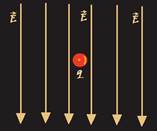
placed in a vertical electric field, with a downward direction and an intensity equal to 500 N/C, is:

67-(UNICAMP-SP)

When a roll of adhesive tape is unrolled, a transfer of negative charges occurs from the tape to the roll, as illustrated in the following figure.
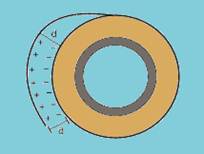
When the electric field created by the distribution of charges is greater than the breakdown electric field of the medium, an electric discharge occurs. It has recently been demonstrated that this discharge can be used as an economical source of X-rays.
In air, dielectric breakdown occurs for electric fields starting from E = 3.0.10 6 V/m . Suppose an electric discharge occurs between the tape and the roll for a potential difference V = 9 kV. In this situation, it can be stated that the maximum distance between the tape and the roll is

68-(MACKENZIE-SP)

The intensity of the electric field vector, at external points, close to an electrified conductive plate, in a vacuum, is given by
E = σ/ε o . In this equation, σ is the surface charge density and ε o is the electric permittivity constant in vacuum. A small sphere, with mass 1.0 g, electrified with charge q = +1.0μC, suspended by an insulating, inextensible, massless string, remains in equilibrium in the indicated position.
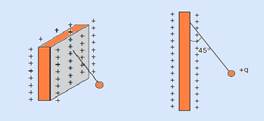
Considering that the magnitude of the local gravitational field vector is g = 10m/s 2 , in this case, the relation , referring to the plate, is
a) σ/ε = 1.0.10 2 V/m
b) σ/ε = 2.0.10 2 V/m
c) σ/ε = 1.0.10 4 V/m
d) σ/ε = 2.0.10 4 V/m
e) σ/ε = 1.0.106 V /m
69-(UEMG-MG)

There are situations in nature that are impossible to occur. Based on this statement, select the alternative below in which a physical phenomenon is presented that does not occur.
A) A mass, when abandoned in a region of space where there is a gravitational field, begins to move in the direction of the gravitational field.
B) An electric charge, when abandoned in a region of space where there is an electric field, begins to move in the opposite direction to the electric field.
C) Two bodies at different temperatures are placed in contact and isolated from their surroundings. Heat flows from the body at the lower temperature to the body at the higher temperature.
D) An electric charge, when abandoned in a region of space where there is an electric field, begins to move in the direction of the electric field.
70-(UFPE-PE)

Three electric charges, q 1 – 16 µC, q-= 2 = + 1.0 µC and q 3 – 4.0 µC, are held fixed in a vacuum and aligned, as shown in the figure.-=

The distance d = 1.0 cm. Calculate the magnitude of the electric field produced at the position of charge q 2 , in V/m.
71-(UFF-RJ)

An electron is removed from one of the plates of a parallel-plate capacitor and is accelerated in a vacuum, from rest, by a constant electric field. This field is produced by a potential difference established between the plates and imparts to the electron a constant acceleration, perpendicular to the plates, of magnitude 6.4.10 3 m/s 2 . The intensity of the electric field is large enough that gravitational effects on the electron can be neglected.
After 2 ms (2.10 -3 s), the polarity of the potential difference established between the plates is abruptly reversed, and the electron begins to experience a force of the same magnitude as the previous force, but in the opposite direction. Because of this, the electron ends up returning to the plate it started from, without having reached the 2nd plate of the capacitor.
a) Sketch, on the grid below, the graph of the electron’s speed as a function of time, from the moment it is removed from the plate until the moment it returns to the same plate.
b) Determine the minimum distance that must exist between the capacitor plates so that the electron does not reach the second plate, as reported.
c) Calculate the time it took for the electron to travel from the moment it was removed from the plate until the moment it returned to its starting point.
d) Determine the magnitude of the electric field responsible for the acceleration of the electron, knowing that its mass is 9.0.10 -31 kg and that its charge is 1.6.10 -19 C.
72-(UERJ-RJ)

Three small metallic spheres, E 1 , E 2 and E 3 , electrically charged and isolated, are aligned, in fixed positions, with E 2 being equidistant from E 1 and E 3 . Their radii have the same value, which is much smaller than the distances between them, as shown in the figure:

The electric charges of the spheres have, respectively, the following values:
Q 1 = 20 μC, Q 2 = – 4 μC and Q 3 = 1 μC.
Assume that, at a certain instant, E 1 and E 2 are connected by a metal wire; after a few seconds, the connection is broken.
In this new configuration, determine the electric charges of E 1 and E 2 and present a diagram with the direction and sense of the resulting force on E 3.