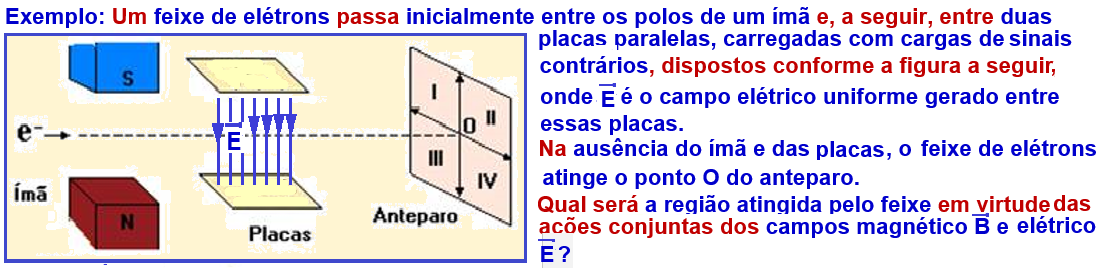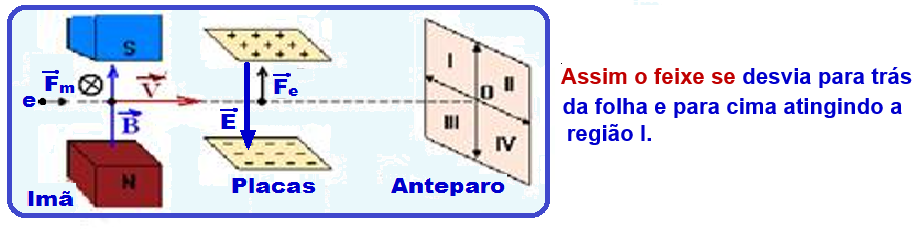
Magnetic force on a moving charge immersed in a magnetic field
MAGNETIC FORCE ON A MOVING CHARGE IMMERSED IN A MAGNETIC FIELD
Magnetic force on a moving charge immersed in a magnetic field
When an electric charge moves at high speed  within a magnetic field
A force of magnetic origin  ( called the Lorentz force) arises over it, with the following characteristics:
 Direction and sense
  provided by the left hand rule as shown in
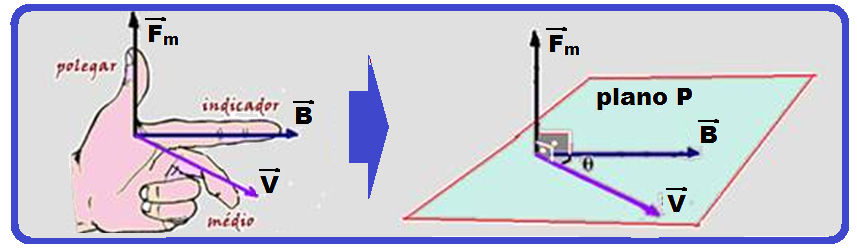
figure above.
Note in the figure on the right that is perpendicular to and to , which imposes the condition that and must belong to the same plane.
Also note that θ is the angle between and .
Knowing the direction and sense of and from you can, using the left-hand rule, determine the direction and sense of the magnetic force as you can see in the diagram below, where a positive charge moves with speed inside a uniform magnetic field.
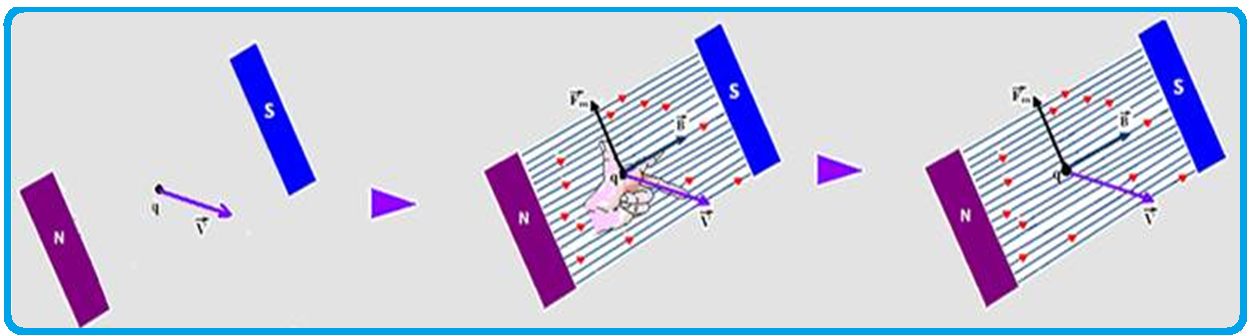
Note that the direction of the lines of magnetic induction and consequently of is from the north pole to the south pole.
By adjusting the index and middle fingers in the directions of and from you determine the direction and sense of .
Note: If q is negative you must reverse the direction of the magnetic force .
What you should know, information and tips

Since the magnetic force always has a direction perpendicular to the velocity vector and since the power of a force is provided by Po = F m .V.cosθ, then θ = 90 o and cos 90 o = 0 Po = F m .V.0 Po = 0 if the power is zero the work will also be , since Po = W/∆t 0 = W/∆t 
W = 0.
The work done by the magnetic force is always zero or, the magnetic force never does work.
Convention
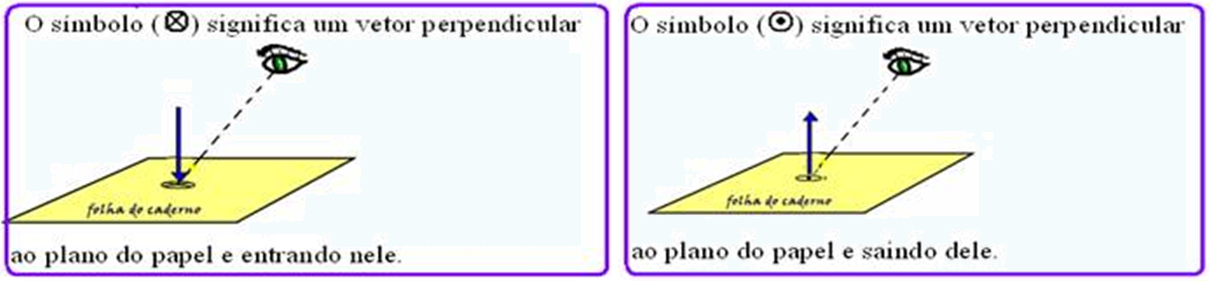
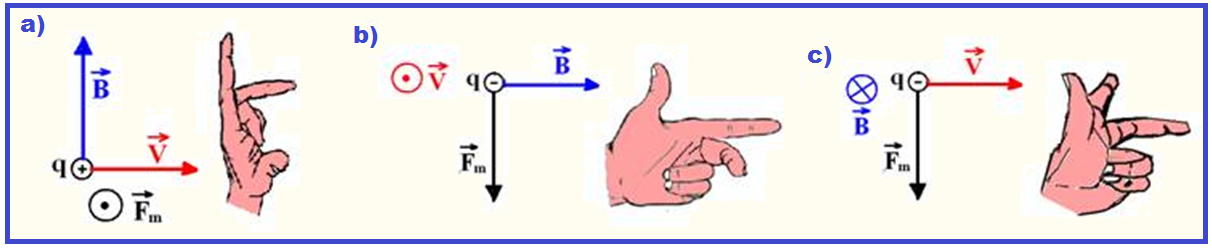
Some examples:
The figures below represent the magnetic forces and the final arrangement of the left hand. Note that in cases b and c the magnetic force has the opposite direction to that given by the left-hand rule, since the electric charge is negative.
Magnetic force on electric charge – particular cases
You have already seen that the main characteristics of the magnetic force that acts on an electric charge immersed in a magnetic field have the following characteristics:
 Direction and sense provided by left hand rule as shown in the figure below.
Note in the figure on the right that is perpendicular to and to , which imposes the condition that and must belong to the same plane. Also note that θ is the angle between and .
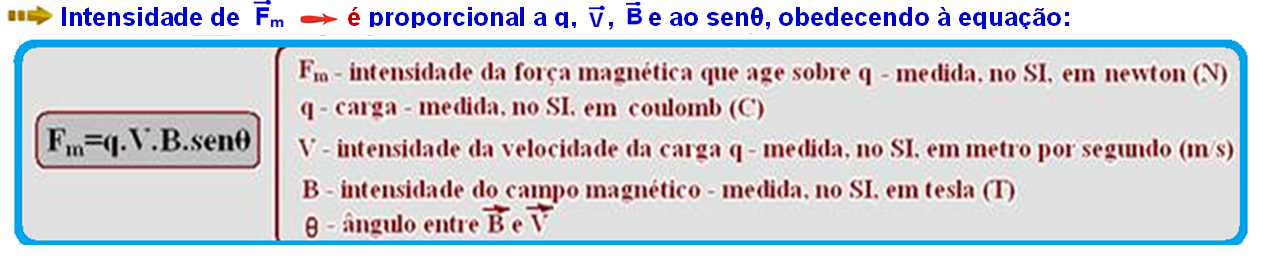
 Intensity of is proportional to q, V, B and senθ, obeying the equation:

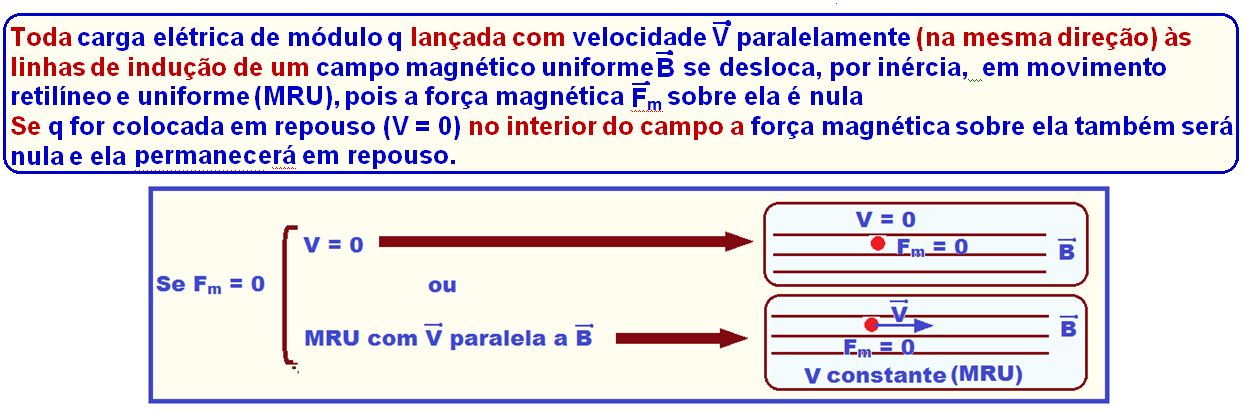
Charge at rest (V = 0) or thrown with velocity parallel to the lines of induction of a uniform magnetic field

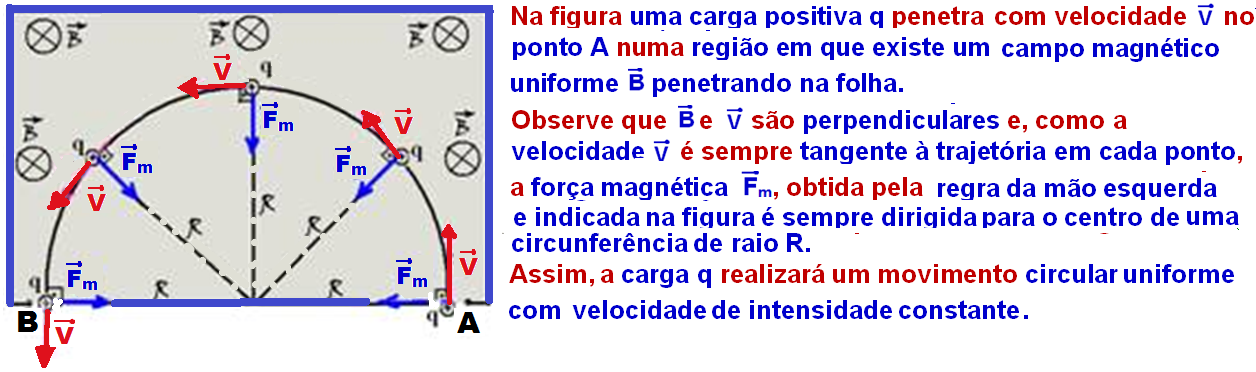
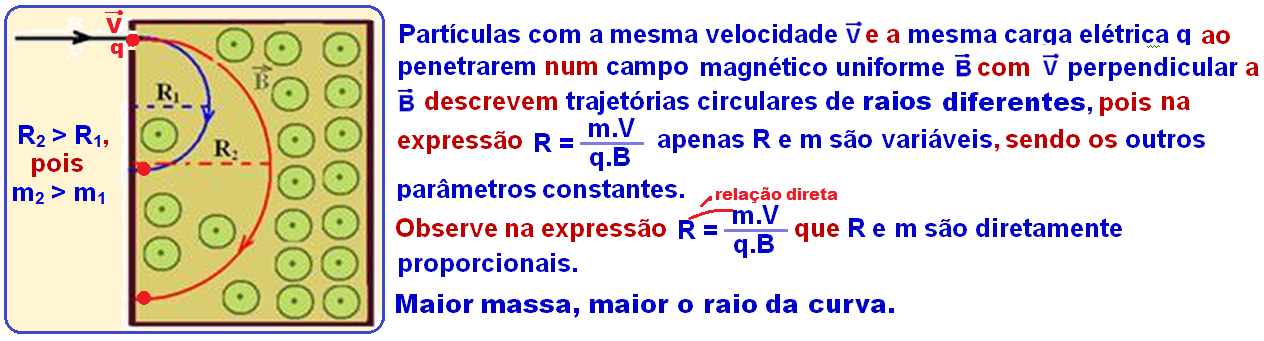
Electric charge q launched with velocity  perpendicular to the lines of induction of a uniform magnetic field
Note that in this case the angle between and is 90 ° (they are perpendicular) and that sin90 ° = 1.

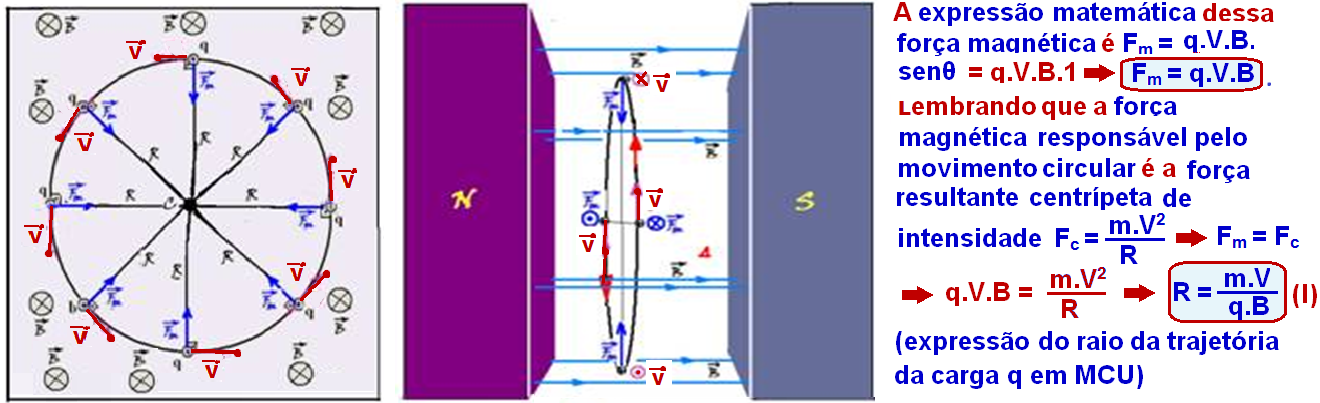

The period T (time that the charge q takes to complete a complete revolution) is given by V = ΔS / Δt in a complete revolution ΔS = 2πR and Δt = T V = 2πR / T (II). 
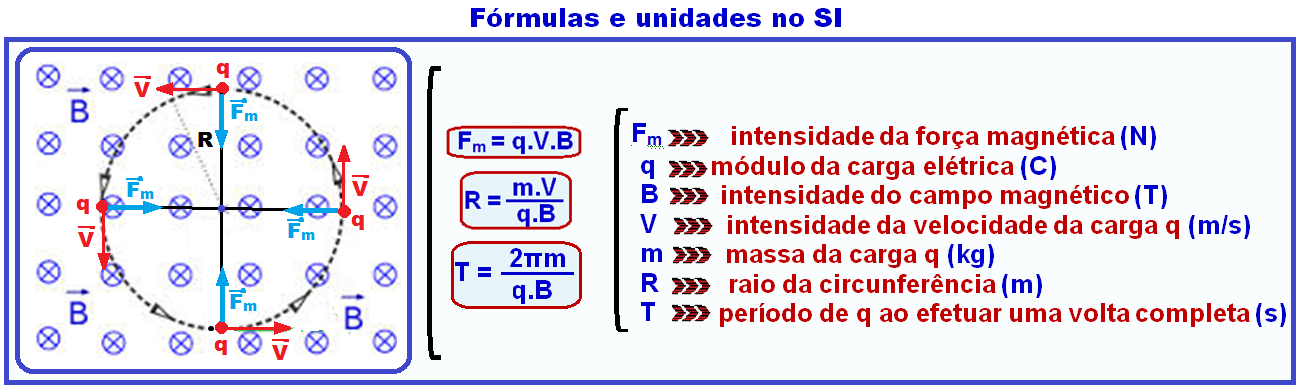
Substituting II in I R = m.(2πR/T)/qB T = 2πm/qB (period of the MCU).
Note that the period (T) of the circular motion does not depend on the speed at which the particle q penetrates the magnetic field nor on the radius of the circumference.

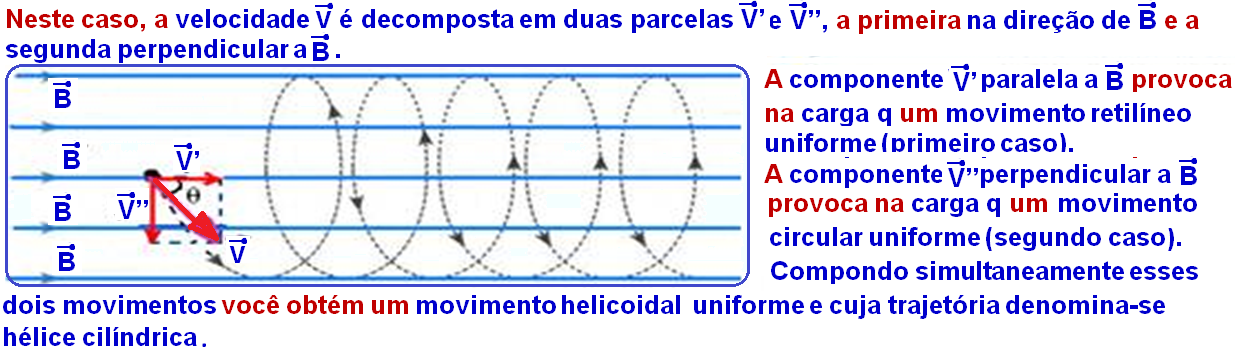
What you should know, information and tips

Note in the expression for the period (T) that it does not depend on the speed of the particle, nor on the radius of the circle.
The work done by on q is zero , since it is perpendicular to the plane formed by e and W = F m .d.cos90 0 = F m .d.0 = 0 .
Magnetic and electric fields acting on a particle or beam of electrified particles with charge q